


Page 219 - Physics Form 5 KSSM_Neat
P. 219
Nuclear fission and nuclear fusion are two nuclear reactions that produce nuclear energy.   CHAPTER 6
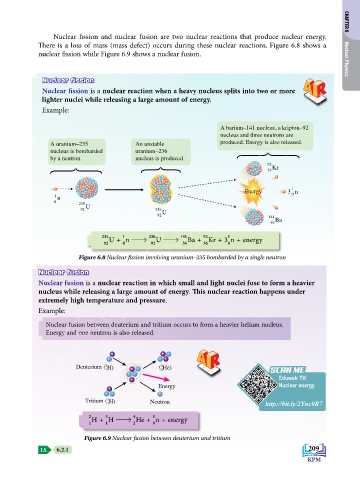
             There is a loss of mass (mass defect) occurs during these nuclear reactions. Figure 6.8 shows a
             nuclear fission while Figure 6.9 shows a nuclear fusion.                                    Nuclear Physics


              Nuclear fission
              KEMENTERIAN PENDIDIKAN MALAYSIA
              Nuclear fission is a nuclear reaction when a heavy nucleus splits into two or more
              lighter nuclei while releasing a large amount of energy.
              Example:


                                                                   A barium–141 nucleus, a kripton–92
                                                                   nucleus and three neutrons are
                A uranium–235             An unstable              produced. Energy is also released.
                nucleus is bombarded      uranium–236
                by a neutron.             nucleus is produced.
                                                                             + +
                                                                             +   92
                                                                           + +     Kr
                                                                           + + + + + + + +  36
                                                                             +
                                                                            +  +
                                                 +
                           +                     +
                          + +  +               +  +
                         +  +                    +
                        +   +  +                +  +
                        + +  +  +  + +         + +  + +  +
                        + + +  +  +             +  +  + +                                1
                        +  + +  + +                +  +                   Energy       3 n
                 1 n     +  + +  + + +         + +  +  +  +  + +                         0
                                                  +
                 0                              + + + +  +
                         235
                           U
                         92                     236 U                       + + +
                                                92                         ++  + + + +  +
                                                                           + + + + + +  141
                                                                            + +  +  56 Ba
                                                                             +  +
                                      1
                                                                     1
                                235   U +  n     236   U     141 Ba +  Kr + 3 n + energy
                                                              92


                                92    0       92        56    36     0
                         Figure 6.8 Nuclear fission involving uranium–235 bombarded by a single neutron
             Nuclear fusion
             Nuclear fusion is a nuclear reaction in which small and light nuclei fuse to form a heavier
             nucleus while releasing a large amount of energy. This nuclear reaction happens under
             extremely high temperature and pressure.
             Example:
               Nuclear fusion between deuterium and tritium occurs to form a heavier helium nucleus.
               Energy and one neutron is also released.
                                  +              +
                                                  +
                                                 4
                                 2
                        Deuterium ( H)  +        ( He)
                                                                                  SCAN ME
                                 1               2                                SCAN ME
                                                                                     Eduweb TV:
                                        +
                                                 Energy                              Nuclear energy
                                 +
                                 3
                           Tritium ( H)       Neutron
                                 1                                               http://bit.ly/2Ync0R7
                                 3
                            2   H +  H     He +  n + energy
                                               1
                                         4


                            1    1       2     0
                          Figure 6.9 Nuclear fusion between deuterium and tritium
             LS     6.2.1                                                                     209

