


Page 236 - Physics Form 5 KSSM_Neat
P. 236
Ideas that Sparked the Quantum Physics Theory
           Light is an electromagnetic wave that is produced from the vibration of an electric charge. In
           a hot object, electrons vibrate rapidly and randomly in any direction and produce light. As the
           object becomes hotter, the vibrations of the electrons become more energetic and more light will
           be emitted. The electrons in a hot object will vibrate in a continuous frequency range. According
           to classical theory, electrons vibrating at the same frequency should have the same energy content.
            KEMENTERIAN PENDIDIKAN MALAYSIA
           The vibration frequency of the electrons also has no limits. Thus, the light energy produced by the
           vibration of electrons can reach unlimited high values.
                However, experimental results involving black-body radiation are inconsistent with classical
           physics theory. Based on the graph of radiation intensity against wavelength for black-body radiation,
           the light intensity on the left side of the peak does not continue to increase with the increase of
           wave frequency as predicted by classical theory. This controversy in the concept of light energy has
           sparked the theory of quantum physics.


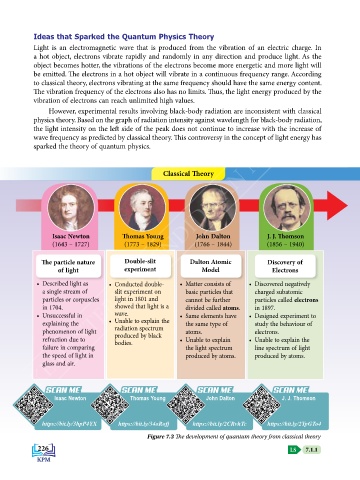
                                                  Classical Theory


                 Isaac Newton         Thomas Young          John Dalton          J. J. Thomson
                 (1643 – 1727)        (1773 – 1829)        (1766 – 1844)         (1856 – 1940)

              The particle nature     Double-slit         Dalton Atomic          Discovery of
                  of light            experiment              Model                Electrons
            •  Described light as   •  Conducted double-     •  Matter consists of   •  Discovered negatively
              a single stream of   slit experiment on    basic particles that   charged subatomic
              particles or corpuscles   light in 1801 and   cannot be further    particles called electrons
              in 1704.             showed that light is a   divided called atoms.  in 1897.
            •  Unsuccessful in     wave.               •  Same elements have   •  Designed experiment to
              explaining the      •  Unable to explain the   the same type of   study the behaviour of
              phenomenon of light   radiation spectrum   atoms.              electrons.
                                   produced by black
              refraction due to    bodies.             •  Unable to explain   •  Unable to explain the
              failure in comparing                       the light spectrum   line spectrum of light
              the speed of light in                      produced by atoms.  produced by atoms.
              glass and air.


                                      SCAN ME
                                                            SCAN ME
               SCAN ME
               SCAN ME                SCAN ME               SCAN ME                SCAN ME
                                                                                   SCAN ME
                 Isaac Newton           Thomas Young           John Dalton            J. J. Thomson
              https://bit.ly/3hpP4YX  https://bit.ly/34oRofj  https://bit.ly/2CRvhTc  https://bit.ly/2YpGTo4
                                             Figure 7.3 The development of quantum theory from classical theory
            226                                                                         LS   7.1.1

