


Page 240 - Physics Form 5 KSSM_Neat
P. 240
Wave-Particle Duality
           Electromagnetic radiation such as light is said to have wave properties because it exhibits
           the phenomena of diffraction and interference. Objects like marbles are said to have particle
           properties because they possess momentum and kinetic energy and can collide with each other.


            KEMENTERIAN PENDIDIKAN MALAYSIA
              Activity       7.3                                                        ISS   ICS

            Aim: To observe the wave properties of a particle and how the de Broglie wavelength changes
                  with mass and particle velocity
            Instructions:
            1.  Carry out this activity in pairs.                                SCAN ME
                                                                                 SCAN ME
            2.  Scan the QR code to view the simulation of the wave properties     Wavelength
               of particles. Based on the simulation, discuss the following:       simulation
               (a)  the wave nature of particles
               (b)  the relationship between the de Broglie wavelength and the
                  mass and velocity of the particle                             http://bit.ly/39xNYqu
            3.  Present your findings.


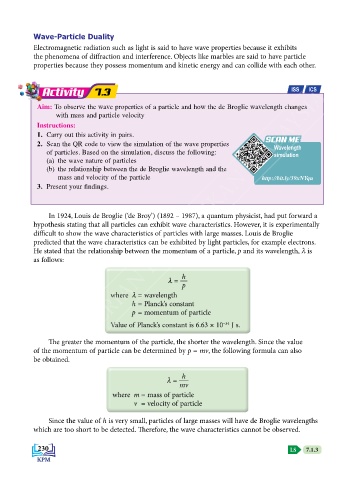
                In 1924, Louis de Broglie (‘de Broy’) (1892 – 1987), a quantum physicist, had put forward a
           hypothesis stating that all particles can exhibit wave characteristics. However, it is experimentally
           difficult to show the wave characteristics of particles with large masses. Louis de Broglie
           predicted that the wave characteristics can be exhibited by light particles, for example electrons.
           He stated that the relationship between the momentum of a particle, p and its wavelength, l is
           as follows:


                The greater the momentum of the particle, the shorter the wavelength. Since the value
           of the momentum of particle can be determined by p = mv, the following formula can also
           be obtained.


                Since the value of h is very small, particles of large masses will have de Broglie wavelengths
           which are too short to be detected. Therefore, the wave characteristics cannot be observed.

            230                                                                         LS   7.1.3

