


Page 28 - Physics Form 5 KSSM_Neat
P. 28
1.3  Forces in Equilibrium

           Photograph 1.4 shows a Ngajat dancer standing
           still for a while during the dance. What is the
           relationship between the forces acting on the
           dancer? Since the acceleration of the dancer is
             KEMENTERIAN PENDIDIKAN MALAYSIA
           zero, there is no resultant force acting on him.
           Therefore, the forces are said to be in equilibrium.
                An object is said to be in equilibrium of
           forces when the forces acting on it produce
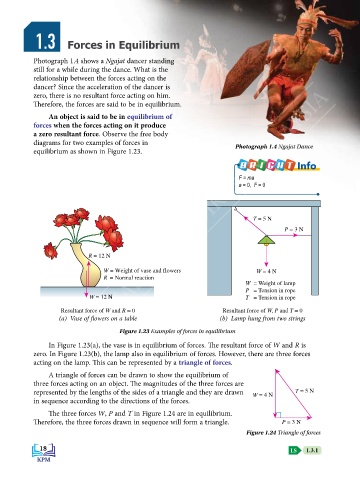
           a zero resultant force. Observe the free body
           diagrams for two examples of forces in
           equilibrium as shown in Figure 1.23.                         Photograph 1.4 Ngajat Dance
                                                                                          Info
                                                                         F = ma
                                                                         a = 0,  F = 0


                                                                             T = 5 N
                                                                                      P = 3 N


                            R = 12 N
                                W = Weight of vase and flowers                W = 4 N
                                R  = Normal reaction
                                                                           W  = Weight of lamp
                                                                         Tiga daya bertindak ke
                                                                           P  = Tension in rope
                                                                         atas lampu
                            W = 12 N                                       T  = Tension in rope
                   Resultant force of W and R = 0                   Resultant force of W, P and T = 0
                   (a)  Vase of flowers on a table                 (b)  Lamp hung from two strings

                                     Figure 1.23 Examples of forces in equilibrium
                In Figure 1.23(a), the vase is in equilibrium of forces. The resultant force of W and R is
           zero. In Figure 1.23(b), the lamp also in equilibrium of forces. However, there are three forces
           acting on the lamp. This can be represented by a triangle of forces.
                A triangle of forces can be drawn to show the equilibrium of
           three forces acting on an object. The magnitudes of the three forces are
           represented by the lengths of the sides of a triangle and they are drawn   W = 4 N  T = 5 N
           in sequence according to the directions of the forces.

                The three forces W, P and T in Figure 1.24 are in equilibrium.
           Therefore, the three forces drawn in sequence will form a triangle.        P = 3 N
                                                                                    Segi tiga daya
                                                                           Figure 1.24 Triangle of forces
             18                                                                         LS   1.3.1

