


Page 58 - Physics Form 5 KSSM_Neat
P. 58
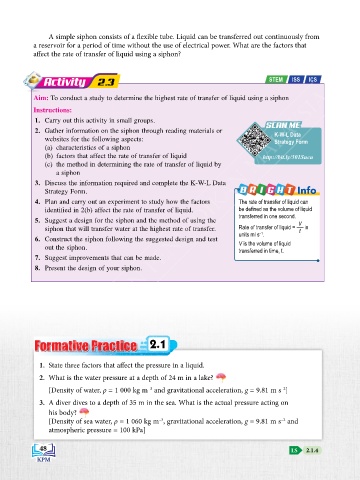
A simple siphon consists of a flexible tube. Liquid can be transferred out continuously from
           a reservoir for a period of time without the use of electrical power. What are the factors that
           affect the rate of transfer of liquid using a siphon?


              Activity        2.3                                                 STEM   ISS  ICS
             KEMENTERIAN PENDIDIKAN MALAYSIA
           Aim: To conduct a study to determine the highest rate of transfer of liquid using a siphon
           Instructions:
            1.  Carry out this activity in small groups.
                                                                                 SCAN ME
                                                                                 SCAN ME
            2.  Gather information on the siphon through reading materials or      K-W-L Data
              websites for the following aspects:                                  Strategy Form
              (a)  characteristics of a siphon
              (b)  factors that affect the rate of transfer of liquid           http://bit.ly/301Sucu
              (c)  the method in determining the rate of transfer of liquid by
                  a siphon
            3.  Discuss the information required and complete the K-W-L Data
              Strategy Form.                                                              Info
            4.  Plan and carry out an experiment to study how the factors   The rate of transfer of liquid can
              identified in 2(b) affect the rate of transfer of liquid.  be defined as the volume of liquid
                                                                         transferred in one second.
            5.  Suggest a design for the siphon and the method of using the                V
              siphon that will transfer water at the highest rate of transfer.  Rate of transfer of liquid =   t   in
                                                                         units ml s .
                                                                               –1
            6.  Construct the siphon following the suggested design and test   V is the volume of liquid
              out the siphon.                                            transferred in time, t.
            7.  Suggest improvements that can be made.
            8.  Present the design of your siphon.


           Formative Practice                 2.1


              1.  State three factors that affect the pressure in a liquid.
              2.  What is the water pressure at a depth of 24 m in a lake?
                 [Density of water, ρ = 1 000 kg m  and gravitational acceleration, g = 9.81 m s ]
                                             –3
                                                                                     –2
              3.  A diver dives to a depth of 35 m in the sea. What is the actual pressure acting on
                his body?
                 [Density of sea water, ρ = 1 060 kg m , gravitational acceleration, g = 9.81 m s  and
                                                                                     –2
                                                 –3
                atmospheric pressure = 100 kPa]
             48                                                                         LS   2.1.4

