


Page 9 - Physics Form 5 KSSM_Neat
P. 9
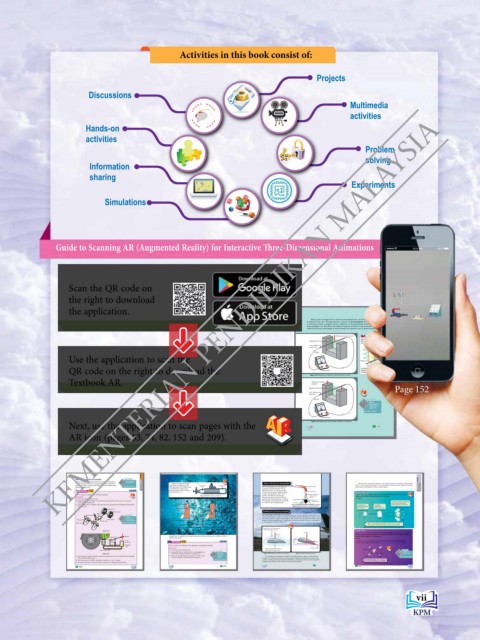
Activities in this book consist of:
Projects
Discussions
Multimedia
activities
KEMENTERIAN PENDIDIKAN MALAYSIA
Hands-on
activities
Problem
solving
Information
sharing
Experiments
Simulations
Guide to Scanning AR (Augmented Reality) for Interactive Three-Dimensional Animations
Scan the QR code on
the right to download
the application.
When a piece of copper wire is moved across magnetic flux, an electromotive force (e.m.f.)
is induced in the wire. This phenomenon is known as electromagnetic induction. If the wire
is connected to form a complete circuit, a deflection of the galvanometer pointer is observed as
shown in Figure 4.18. This shows that induced current is produced. An electromotive force is also
induced in the wire if the magnet is moved towards the stationary wire as shown in Figure 4.19.
Direction of motion of wire Info GALLERY
S Magnetic flux refers to magnetic
Magnetic flux field lines that pass through
a surface.
e.m.f. induced N
in the wire Magnetic field line
Current
Use the application to scan the 20 30 10 0 10 G 20 30 Surface
Moving conductor
QR code on the right to download the Galvanometer A conductor that moves and cuts
magnetic field lines can be said to
cut magnetic flux.
Figure 4.18 Magnets are stationary while conductor is moved
Textbook AR. Direction of motion of
magnets
Magnetic flux S Page 152
e.m.f. induced N
in the wire
SCAN ME
Current SCAN ME
Video of
0 10 electromagnetic
20 10 20 30
30 induction for a
G
copper wire
http://bit.ly/34t4c47
Galvanometer
Next, use the application to scan pages with the 152 Figure 4.19 Magnets are moved while conductor is stationary LS 4.2.1
AR icon (pages 63, 74, 82, 152 and 209).
Applications of Pascal's Principle SCAN ME CHAPTER 2
SCAN ME
Pascal's principle is applied in hydraulic systems. A small input Characteristics of Pressure
hydraulic fluid
force is multiplied to become a larger output force to perform a Figure 2.36 shows the ballast Effect of Lift Force on a Ping Pong Ball Nuclear fission and nuclear fusion are two nuclear reactions that produce nuclear energy. CHAPTER 6 Nuclear Physics
specific task. How is this principle applied in the hydraulic brake http://bit.ly/2N8Ntty tanks found in a submarine. The Ballast tank Ballast tank Lift force is produced from the difference Air Silicone tube There is a loss of mass (mass defect) occurs during these nuclear reactions. Figure 6.8 shows a
and the hydraulic jack? working principle of the ballast tanks in pressure caused by the flow of air at nuclear fission while Figure 6.9 shows a nuclear fusion.
in a submarine is similar to the
Activity 2.8 ISS ICS working principle of the Cartesian different velocities. Air flowing at a high Filter funnel Nuclear fission
velocity above the ping pong ball as shown
diver in Activity 2.11.
in Figure 2.49 produces a region of low
Aim: To discuss the applications of Pascal's principle Region of high air Nuclear fission is a nuclear reaction when a heavy nucleus splits into two or more
Figure 2.36 Ballast tanks in a submarine pressure. The difference between the
Instructions: high pressure below the ball and the low speed and low lighter nuclei while releasing a large amount of energy.
pressure
Example:
1. Carry out a Round Table activity. pressure above the ball produces a resultant Ping pong ball Region of
2. Study Figure 2.24 and Figure 2.25 which show the hydraulic brake system of a car and a force upwards. This resultant force is the lift high pressure A barium–141 nucleus, a kripton–92
hydraulic jack respectively. Test tube floats force that lifts up the ping pong ball. Lift force
produced. Energy is also released.
3. Scan the QR code to watch the video that shows the operations of the hydraulic brake and the on the surface Trapped air A uranium–235 An unstable nucleus and three neutrons are
hydraulic jack. of water Figure 2.49 Effect of lift force on the ping pong ball nucleus is bombarded uranium–236
by a neutron. nucleus is produced.
Brake shoe Water in the + + + + + 92 Kr
test tube + + + + + + + + + 36
sinks
Brake drum Test tube Trapped air Production of Lift Force by the Aerofoil + + + + + + + + + +
Master + + + + + + + + + + + + + + + + +
Brake pedal cylinder SCAN ME The aerofoil shape of the wing of an aeroplane causes air to flow at different speeds past the top 1 n + + + + + + + + + + + + + + + + + + + + + + + + + + + + + + + + + + + + + Energy 3 1 n 0
SCAN ME
Video of section and the bottom section. According to Bernoulli's principle, the higher air velocity at the 0 235 U 92 236 U
top section produces a region of low pressure while the lower air velocity at the bottom section
applications of
Brake pad Slave cylinder Pascal's principle (a) Test tube floating on the surface of water (b) Test tube sinks in the water produces a region of high pressure. This difference in pressure produces a lift force acting upwards 92 + + + ++ + + + + + + + + + + + + + + + + 141 Ba
Brake fluid 56
Brake disc http://bit.ly/2N6pk6H on the aeroplane as shown in Figure 2.50. 235 U + 1 n 92 U 236 141 Ba + 92 Kr + 3 1 n + energy
Figure 2.37 Working principle of ballast tanks in a submarine 92 0 56 36 0
Figure 2.37 shows the working principle of ballast tanks using the Cartesian diver. When the Figure 6.8 Nuclear fission involving uranium–235 bombarded by a single neutron
test tube is floating on the surface of the water, the total weight of the test tube and the weight of Region of air flow at high velocity
Figure 2.24 the water in it is equal to the buoyant force. The pressure exerted on the wall of the bottle causes creates region of low pressure Nuclear fusion
water to be pushed into the test tube. This causes the weight of water in the test tube to increase. Lift force Nuclear fusion is a nuclear reaction in which small and light nuclei fuse to form a heavier
Therefore, the total weight of the test tube and the weight of the water in it is greater than the Lift force nucleus while releasing a large amount of energy. This nuclear reaction happens under
Handle buoyant force. A resultant force acting downwards is produced and causes the test tube to sink to extremely high temperature and pressure.
Large piston the base of the bottle. Example:
Aerofoil Aerofoil
Small Fluid ISS ICS Air Drag Nuclear fusion between deuterium and tritium occurs to form a heavier helium nucleus.
piston reservoir Activity 2.12 flow Energy and one neutron is also released.
Angle of attack
Valve A Valve B Hydraulic Aim: To search for information on the applications of Archimedes' principle
fluid + +
Instructions: Region of air flow at low velocity Chord line +
SCAN ME
Release valve 1. Carry out a Gallery Walk activity. creates region of high pressure Deuterium ( 2 H) 1 + ( 4 He) 2 SCAN ME
Eduweb TV:
SCAN ME
2. Scan the QR code to watch the video on the applications of SCAN ME +
Figure 2.25 Archimedes' principle for the three examples given. Video on the Figure 2.50 Production of lift force by the aerofoil Figure 2.51 Angle of attack on aerofoil + Energy Nuclear energy
applications of
4. Surf websites to gather information about the application of Pascal's principle in the hydraulic 3. Then, scan the QR code given on page 75 or refer to other Archimedes’ The total lift force acting on the aeroplane is also affected by the angle of attack as shown Tritium ( 3 H) 1 Neutron http://bit.ly/2Ync0R7
brake and the hydraulic jack. in Figure 2.51. When the aerofoil is at a certain angle of attack, the aerofoil exerts a force on the
reference materials to obtain further information on:
principle
0
2
1
5. Each group has to record the information obtained on a piece of paper. http://bit.ly/35AE3gM air flow. According to Newton's Third Law of Motion, a reaction force will act on the wing of the 2 H + 3 H 1 4 He + 1 n + energy
6. Present the outcome of your discussion in the form of a multimedia presentation. aeroplane and contribute to the lift force that acts on the aeroplane.
Figure 6.9 Nuclear fusion between deuterium and tritium
LS 2.4.3 63 74 LS 2.5.3 82 LS 2.6.2 LS 6.2.1 209
PB vii

