


Page 97 - Physics Form 5 KSSM_Neat
P. 97
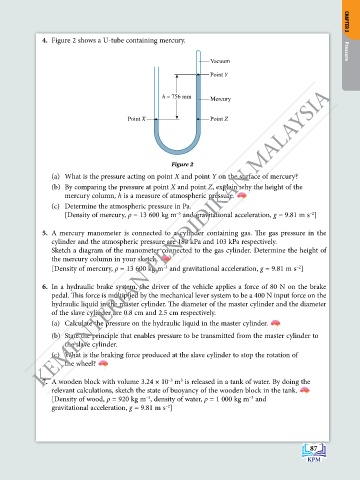
4.  Figure 2 shows a U-tube containing mercury.                                           CHAPTER 2


                                                                Vacuum                                   Pressure

                                                                Point Y
              KEMENTERIAN PENDIDIKAN MALAYSIA
                                                  h = 756 mm    Mercury


                                       Point X                  Point Z


                                                    Figure 2
                (a)  What is the pressure acting on point X and point Y on the surface of mercury?
                (b)  By comparing the pressure at point X and point Z, explain why the height of the
                    mercury column, h is a measure of atmospheric pressure.
                (c)  Determine the atmospheric pressure in Pa.
                    [Density of mercury, ρ = 13 600 kg m  and gravitational acceleration, g = 9.81 m s ]
                                                      –3
                                                                                              –2
               5.  A  mercury  manometer is  connected  to  a cylinder  containing  gas.  The gas pressure in  the
                cylinder and the atmospheric pressure are 180 kPa and 103 kPa respectively.
                Sketch a diagram of the manometer connected to the gas cylinder. Determine the height of
                the mercury column in your sketch.
                [Density of mercury, ρ = 13 600 kg m  and gravitational acceleration, g = 9.81 m s ]
                                                                                          –2
                                                  –3
               6.  In a hydraulic brake system, the driver of the vehicle applies a force of 80 N on the brake
                pedal. This force is multiplied by the mechanical lever system to be a 400 N input force on the
                hydraulic liquid in the master cylinder. The diameter of the master cylinder and the diameter
                of the slave cylinder are 0.8 cm and 2.5 cm respectively.
                (a)  Calculate the pressure on the hydraulic liquid in the master cylinder.
                (b)  State the principle that enables pressure to be transmitted from the master cylinder to
                    the slave cylinder.
                (c)  What is the braking force produced at the slave cylinder to stop the rotation of
                    the wheel?


               7.  A wooden block with volume 3.24 × 10  m  is released in a tank of water. By doing the
                                                       3
                                                    –3
                relevant calculations, sketch the state of buoyancy of the wooden block in the tank.
                [Density of wood, ρ = 920 kg m , density of water, ρ = 1 000 kg m  and
                                                                            –3
                                             –3
                gravitational acceleration, g = 9.81 m s ]
                                                   –2


                                                                                              87

