


Page 70 - DnD_5e_Players_Handbook_(BnW_OCR)
P. 70
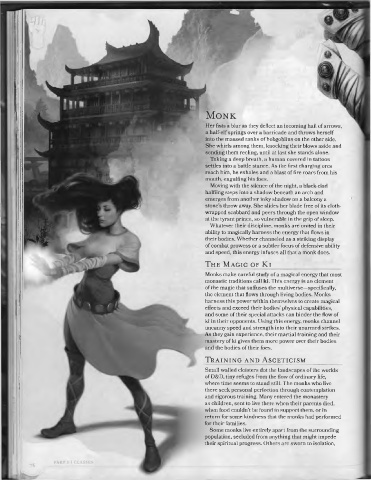
M o n k
                                                                     Her fists a blur as they deflect an incom ing hail of arrows,
                                                                     a half-elf springs over a barricade and throws herself
                                                                     into the m assed ranks o f hobgoblins on the other side.
                                                                     She whirls am ong them, knocking their blows aside and
                                                                     sending them reeling, until at last she stands alone.
                                                                       Taking a deep breath, a human covered in tattoos
                                                                     settles into a battle stance. As the first charging orc s
                                                                     reach him, he exhales and a blast o f fire roars from  his
                                                                     mouth, engulfing his foes.
                                                                       Moving with the silence of the night, a black-clad
                                                                     halfling steps into a shadow beneath an arch and
                                                                     em erges from  another inky shadow on a balcony a
                                                                     stone’s throw away. She slides her blade free o f its cloth-
                                                                     wrapped scabbard and peers through the open window
                                                                     at the tyrant prince, so vulnerable in the grip o f sleep.
                                                                      Whatever their discipline, m onks are united in their
                                                                     ability to magically harness the energy that flows in
                                                                     their bodies. W hether channeled as a striking display
                                                                     of com bat prowess or a subtler focus o f defensive ability
                                                                     and speed, this energy infuses all that a monk does.
                                                                     T h e   M a g i c   o f   K i
                                                                     M onks make careful study o f a magical energy that most
                                                                     monastic traditions call ki. This energy is an element
                                                                     of the magic that suffuses the multiverse—specifically,
                                                                     the element that flows through living bodies. M onks
                                                                     harness this power within themselves to create magical
                                                                     effects and exceed their bodies' physical capabilities,
                                                                     and som e of their special attacks can hinder the flow of
                                                                     ki in their opponents. Using this energy, m onks channel
                                                                     uncanny speed and strength into their unarm ed strikes.
                                                                     As they gain experience, their martial training and their
                                                                     mastery of ki gives them m ore power over their bodies
                                                                     and the bodies of their foes.
                                                                     T r a i n i n g   a n d   A s c e t i c i s m
                                                                     Sm all walled cloisters dot the landscapes o f the worlds
                                                                     o f D&D, tiny refuges from  the flow of ordinary life,
                                                                     where time seem s to stand still. The m onks w ho live
                                                                     there seek personal perfection through contemplation
                                                                     and rigorous training. Many entered the monastery
                                                                     as children, sent to live there when their parents died,
                                                                     when food couldn’t be found to support them, or in
                                                                     return for som e kindness that the m onks had perform ed
                                                                     for their families.
                                                                      S om e m onks live entirely apart from the surrounding
                                                                     population, secluded from anything that might impede
                                                                     their spiritual progress. Others are sworn to isolation,

