


Page 66 - MACHINE TOOLS WORLD - DECEMBER 2021
P. 66
TECH INNOVATION


           HIGH-END MULTI-PRESENCE


                ack in the early 2000s, the introduction of ISCAR’s MULTI-  replacement.  It has been frequently asked what the secrets are
                MASTER system of rotating tools with interchangeable   of the MULTI-MASTER’s success and what are the features that
          Bcarbide heads played a significant role in the development   ensure its popularity and longevity of the product.
           of cutting tools. Tool assemblies with exchangeable heads were   Aside from the benefits outlined above, which are crucial for
           known long before ISCAR’s MULTI-MASTER.  This was a product   tools with exchangeable threaded heads, the MULTI-MASTER
           that changed the traditional view of the design concept of such   provides high dimensional repeatability with its face-contact
           systems.                                            design concept. This concept holds the “no setup” principle
             Within the MULTI-MASTER product line, heads are secured   for replacing a worn head - no additional setup operations for
           by using a thread connection. Cemented carbide is a very hard   adjustment are necessary and the head can be changed without
           and wear-resistant material and has lower impact strength when   removing the tool from the machine.
           compared to high-speed steel. In a threaded carbide part, the   Another unique aspect of the MULTI-MASTER is its very wide
           thread is a source of stress concentrators that is crucial for tool   variety of heads that cover a broad-spectrum of applications
           functioning, especially under cyclic loading. Rotating tools with   in milling, hole making, engraving, and gearing.  In milling
           exchangeable carbide heads are reasonable in a relatively small   operations, these cover square shoulders, faces, 3D surfaces,
           diameter range, typically 6-25 mm (.25”-1.00”), which limits   chamfers, cavities and pockets, slots and grooves, threads, and
           appropriate thread diameters and the height of a thread profile.   machining by high-speed- and high-feed milling methods. And in
             The above points make it problematic to use standard threads   Holemaking operations, center & spot drilling, countersinking, etc.
           and strongly determine a special thread shape to comply with the   Combining two types of heads is a beneficial combination of
           specifications of the connection. Therefore, a thread connection as   two design approaches: fully ground heads from solid blanks and
           the head clamping element was highly questionable. Fortunately,   heads from pre-shaped sintered inserts. Together with a wide
           the MULTI-MASTER, which is based on the threads of a specially   choice of shanks, adaptors, and reducers significantly simplifies
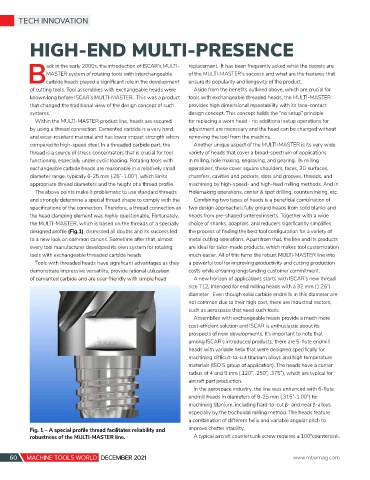
           designed profile (Fig.1), dismissed all doubts and its success led   the process of finding the best tool configuration for a variety of
           to a new look on common canons. Sometime after that, almost   metal cutting operations. Apart from that, the line and its products
           every tool manufacturer developed its own system for rotating   are ideal for tailor-made products, which makes tool customization
           tools with exchangeable threaded carbide heads.     much easier. All of this turns the robust MULTI-MASTER line into
             Tools with threaded heads have significant advantages as they   a powerful tool for improving productivity and cutting production
           demonstrate impressive versatility, provide rational utilization   costs while ensuring longstanding customer commitment.
           of cemented carbide and are user-friendly with simple head   A new horizon of applications starts with ISCAR’s new thread
                                                               size T12, intended for end milling heads with a 32 mm (1.25”)
                                                               diameter.  Even though solid carbide endmills in this diameter are
                                                               not common due to their high cost, there are industrial sectors,
                                                               such as aerospace that need such tools.
                                                                 Assemblies with exchangeable heads provide a much more
                                                               cost-efficient solution and ISCAR is enthusiastic about its
                                                               prospects of new developments. It’s important to note that
                                                               among ISCAR’s introduced products, there are 5-flute endmill
                                                               heads with variable helix that were designed specifically for
                                                               machining difficult-to-cut titanium alloys and high temperature
                                                               materials (ISO S group of application). The heads have a corner
                                                               radius of 4 and 5 mm (.120”, .250”, .375”), which are typical for
                                                               aircraft part production.
                                                                 In the aerospace industry, the line was enhanced with 6-flute
                                                               endmill heads in diameters of 8-25 mm (.315”-1.00”) for
                                                               machining titanium, including hard-to-cut β- and near β-alloys
                                                               especially by the trochoidal milling method. The heads feature
                                                               a combination of different helix and variable angular pitch to
           Fig. 1 – A special profile thread facilitates reliability and   improve chatter stability.
           robustness of the MULTI-MASTER line.                  A typical aircraft countersunk screw requires a 100°countersink.


     60     MACHINE TOOLS WORLD DECEMBER 2021                                                     www.mtwmag.com

