


Page 52 - MTW November 2022 Digital Magazine_R1
P. 52
TECH INNOVATION


           Face Milling for High Surface Finish


           In the metalworking industry, ensuring a high-grade surface finish has always been one of the main directions in
           cutting tool development. This is also true for indexable face milling cutters.


                 espite significant improvement in the high surface quality
                 of milled surfaces, tool designers still believe that available
          Dresources have not yet exhausted and that intelligent
           applications of the last generations of advanced milling cutters
           can substantially improve surface texture.
             When considering an indexable milling cutter, the key factors
           that determine the quality of a generated surface are the
           cutter’sgeometry and accuracy.  Both characteristics are mainly
           related to inserts carried by the cutter.
             Powder metallurgy processing has enabled producing carbide
           inserts with complex shapes, ensuring optimal cutting geometry
           while maintaining substantially increased accuracy of inserts
           as sintered inserts. Not surprisingly, such advancements in
           technology have significantly improved the surface finish in
           face milling. However, when indexable milling cutters were
           successfully applied to machining high-strength materials, and
           manufacturers started to notice hard milling as an alternative to
           grinding, the metalworking industry started demanding higher
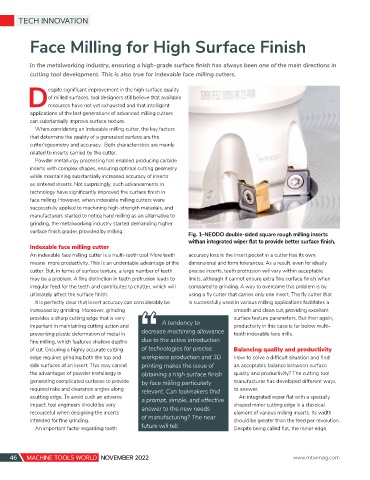
           surface finish grades provided by milling.          Fig. 1–NEODO double-sided square rough milling inserts
                                                               withan integrated wiper flat to provide better surface finish.
           Indexable face milling cutter
           An indexable face milling cutter is a multi-tooth tool. More teeth   accuracy loss is the insert pocket in a cutter has its own
           means  more productivity. This is an undeniable advantage of the   dimensional and form tolerances. As a result, even for ideally
           cutter. But, in terms of surface texture, a large number of teeth   precise inserts, teeth protrusion will vary within acceptable
           may be a problem. A fine distinction in teeth protrusion leads to   limits, although it cannot ensure extra fine surface finish when
           irregular feed for the teeth and contributes to chatter, which will   compared to grinding. A way to overcome this problem is by
           ultimately affect the surface finish.               using a fly cutter that carries only one insert. The fly cutter that
             It is perfectly clear that insert accuracy can considerably be   is successfully used in various milling applications facilitates a
           increased by grinding. Moreover, grinding                          smooth and clean cut, providing excellent
           provides a sharp cutting edge that is very                         surface texture parameters. But then again,
           important in maintaining cutting action and   A tendency to        productivity in this case is far below multi-
           preventing plastic deformation of metal in   decrease machining allowance   tooth indexable face mills.
           fine milling, which features shallow depths   due to the active introduction
           of cut. Ensuring a highly accurate cutting   of technologies for precise   Balancing quality and productivity
           edge requires grinding both the top and   workpiece production and 3D   How to solve a difficult situation and find
           side surfaces of an insert. This may cancel   printing makes the issue of   an acceptable balance between surface
           the advantages of powder metallurgy in   obtaining a high surface finish   quality and productivity? The cutting tool
           generating complicated surfaces to provide   by face milling particularly   manufacturer has developed different ways
           required rake and clearance angles along   relevant. Can toolmakers find   to answer.
           acutting edge. To avoid such an adverse   a prompt, simple, and effective   An integrated wiper flat with a specially
           impact, tool engineers should be very                              shaped minor cutting edge is a classical
           resourceful when designing the inserts   answer to the new needs   element of various milling inserts. Its width
           intended for fine grinding.          of manufacturing? The near    should be greater than the feed per revolution.
             An important factor regarding tooth   future will tell.          Despite being called flat, the minor edge


     46     MACHINE TOOLS WORLD NOVEMBER 2022                                                     www.mtwmag.com

