


Page 54 - MTW November 2022 Digital Magazine_R1
P. 54
TECH INNOVATION


           sometimes has a complex geometry to compensate a negative
           effect of wear development. When an insert is mounted on a
           cutter, the wiper flat sits parallel to the machined surface. Hence,
           the surface will be formed by the most protruding insert of the
           cutter. Introducing a wiper flat in an insert design is an effective
           way to improve surface finish.  And even today, rough milling
           inserts may have an integrated wiper (Fig. 1).
             ISCAR’s DOVEIQMILL family face mill carries double-sided
           inserts with a wide wiper flat. These tools are intended for rough
           and semi-rough milling with surface roughness that usually
           features semi-finish to finish passes.The DOVEIQMILL cutters
           have successfully delivered the hopes of their designers – and the
           adoption of the cutters in various processes resulted in cancelling
           finish milling operations. The cutters provide roughness Ra up to
           0.4µm (16 µin) when milling steel and cast iron.
             Increasing the number of teeth in big-diameter face mills and fine
           pitch cutters determines the appropriate growth of the integrated
           wiper width, which has a natural bound due to design and
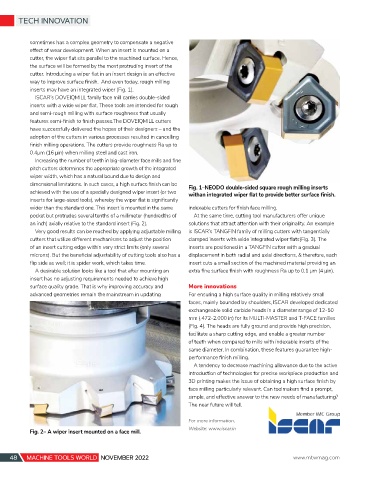
           dimensional limitations. In such cases, a high surface finish can be   Fig. 1–NEODO double-sided square rough milling inserts
           achieved with the use of a specially designed wiper insert (or two   withan integrated wiper flat to provide better surface finish.
           inserts for large-sized tools), whereby the wiper flat is significantly
           wider than the standard one. This insert is mounted in the same   indexable cutters for finish face milling.
           pocket but protrudes several tenths of a millimeter (hundredths of   At the same time, cutting tool manufacturers offer unique
           an inch) axially relative to the standard insert (Fig. 2).  solutions that attract attention with their originality. An example
             Very good results can be reached by applying adjustable milling   is ISCAR’s TANGFIN family of milling cutters with tangentially
           cutters that utilize different mechanisms to adjust the position   clamped inserts with wide integrated wiper flats(Fig. 3). The
           of an insert cutting edge within very strict limits (only several   inserts are positioned in a TANGFIN cutter with a gradual
           microns). But the beneficial adjustability of cutting tools also has a   displacement in both radial and axial directions, & therefore, each
           flip side as well; it is spider work, which takes time.  insert cuts a small section of the machined material providing an
             A desirable solution looks like a tool that after mounting an   extra fine surface finish with roughness Ra up to 0.1 μm (4 μin).
           insert has no adjusting requirements needed to achieve high
           surface quality grade. That is why improving accuracy and   More innovations
           advanced geometries remain the mainstream in updating   For ensuring a high surface quality in milling relatively small
                                                               faces, mainly bounded by shoulders, ISCAR developed dedicated
                                                               exchangeable solid carbide heads in a diameter range of 12-50
                                                               mm (.472-2.000 in) for its MULTI-MASTER and T-FACE families
                                                               (Fig. 4). The heads are fully ground and provide high precision,
                                                               facilitate a sharp cutting edge, and enable a greater number
                                                               of teeth when compared to mills with indexable inserts of the
                                                               same diameter. In combination, these features guarantee high-
                                                               performance finish milling.
                                                                 A tendency to decrease machining allowance due to the active
                                                               introduction of technologies for precise workpiece production and
                                                               3D printing makes the issue of obtaining a high surface finish by
                                                               face milling particularly relevant. Can toolmakers find a prompt,
                                                               simple, and effective answer to the new needs of manufacturing?
                                                               The near future will tell.

                                                               For more information,
           Fig. 2– A wiper insert mounted on a face mill.      Website: www.iscar.in


     48     MACHINE TOOLS WORLD NOVEMBER 2022                                                     www.mtwmag.com

