


Page 121 - Critical Care Nursing Demystified
P. 121
106        CRITICAL CARE NURSING  DeMYSTIFIED


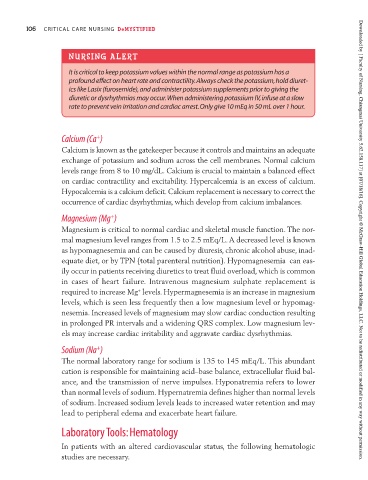
                              NURSING ALERT

                              It is critical to keep potassium values within the normal range as potassium has a
                              profound effect on heart rate and contractility. Always check the potassium, hold diuret-
                              ics like Lasix (furosemide), and administer potassium supplements prior to giving the
                              diuretic or dysrhythmias may occur. When administering potassium IV, infuse at a slow
                              rate to prevent vein irritation and cardiac arrest. Only give 10 mEq in 50 mL over 1 hour.


                                      +
                            Calcium (Ca )
                            Calcium is known as the gatekeeper because it controls and maintains an adequate
                            exchange of potassium and sodium across the cell membranes. Normal calcium
                            levels range from 8 to 10 mg/dL. Calcium is crucial to maintain a balanced effect
                            on cardiac contractility and excitability. Hypercalcemia is an excess of calcium.
                            Hypocalcemia is a calcium deficit. Calcium replacement is necessary to correct the
                            occurrence of cardiac dsyrhythmias, which develop from calcium imbalances.

                                          +
                            Magnesium (Mg )
                            Magnesium is critical to normal cardiac and skeletal muscle function. The nor-
                            mal magnesium level ranges from 1.5 to 2.5 mEq/L. A decreased level is known        Downloaded by [ Faculty of Nursing, Chiangmai University 5.62.158.117] at [07/18/16]. Copyright © McGraw-Hill Global Education Holdings, LLC. Not to be redistributed or modified in any way without permission.
                            as hypomagnesemia and can be caused by diuresis, chronic alcohol abuse, inad-
                            equate diet, or by TPN (total parenteral nutrition). Hypomagnesemia  can eas-
                            ily occur in patients receiving diuretics to treat fluid overload, which is common
                            in cases of heart failure. Intravenous magnesium sulphate replacement is
                            required to increase Mg  levels. Hypermagnesemia is an increase in magnesium
                                                  +
                            levels, which is seen less frequently then a low magnesium level or hypomag-
                            nesemia. Increased levels of magnesium may slow cardiac conduction resulting
                            in prolonged PR intervals and a widening QRS complex. Low magnesium lev-
                            els may increase cardiac irritability and aggravate cardiac dysrhythmias.

                                      +
                            Sodium (Na )
                            The normal laboratory range for sodium is 135 to 145 mEq/L. This abundant
                            cation is responsible for maintaining acid–base balance, extracellular fluid bal-
                            ance, and the transmission of nerve impulses. Hyponatremia refers to lower
                            than normal levels of sodium. Hypernatremia defines higher than normal levels
                            of sodium. Increased sodium levels leads to increased water retention and may
                            lead to peripheral edema and exacerbate heart failure.

                            Laboratory Tools: Hematology

                            In patients with an altered cardiovascular status, the following hematologic
                            studies are necessary.

