


Page 116 - Critical Care Nursing Demystified
P. 116
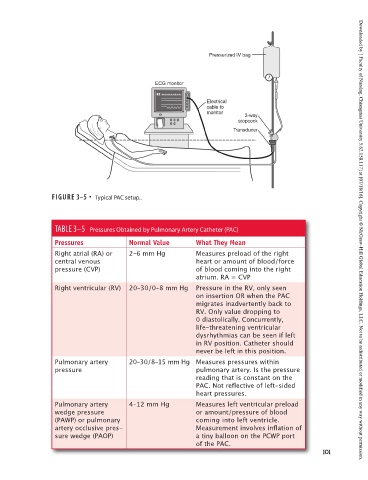
Pressurized IV bag


                                                           ECG monitor

                                                                          Electrical
                                                                          cable to
                                                                          monitor
                                                                                    3-way
                                                                                   stopcock
                                                                                 Transducer


                               FIGURE 3–5  •   Typical PAC setup..


                               TABLE 3–5  Pressures Obtained by Pulmonary Artery Catheter (PAC)

                               Pressures            Normal Value       What They Mean                               Downloaded by [ Faculty of Nursing, Chiangmai University 5.62.158.117] at [07/18/16]. Copyright © McGraw-Hill Global Education Holdings, LLC. Not to be redistributed or modified in any way without permission.
                               Right atrial (RA) or   2–6 mm Hg        Measures preload of the right
                               central venous                          heart or amount of blood/force
                               pressure (CVP)                          of blood coming into the right
                                                                       atrium. RA = CVP
                               Right ventricular (RV)  20–30/0–8 mm Hg  Pressure in the RV, only seen
                                                                       on insertion OR when the PAC
                                                                       migrates inadvertently back to
                                                                       RV. Only value dropping to
                                                                       0 diastolically. Concurrently,
                                                                       life-threatening ventricular
                                                                       dysrhythmias can be seen if left
                                                                       in RV position. Catheter should
                                                                       never be left in this position.
                               Pulmonary artery     20–30/8–15 mm Hg Measures pressures within
                               pressure                                pulmonary artery. Is the pressure
                                                                       reading that is constant on the
                                                                       PAC. Not reflective of left-sided
                                                                       heart pressures.
                               Pulmonary artery     4–12 mm Hg         Measures left ventricular preload
                               wedge pressure                          or amount/pressure of blood
                               (PAWP) or pulmonary                     coming into left ventricle.
                               artery occlusive pres-                  Measurement involves inflation of
                               sure wedge (PAOP)                       a tiny balloon on the PCWP port
                                                                       of the PAC.
                                                                                                          101

