


Page 153 - Critical Care Nursing Demystified
P. 153
138        CRITICAL CARE NURSING  DeMYSTIFIED


                              suddenly due to a severe MI, rupture of a coronary artery during angioplasty, or
                            multiple trauma as in the chest being crushed between a car seat and a steering
                            wheel (blunt trauma). It can also occur slowly as in the build up of fluid from
                            a pericardial tumor or radiation pericarditis.
                               Because the heart cannot fill properly, venous return (preload) increases
                            dramatically, allowing very little blood to get into the heart. The increased pre-
                            load causes blood to back up into the venous system. The heart cannot pump
                            effectively when the atrial valves and ventricles are squeezed; therefore, con-
                            tractility decreases. Since blood cannot get out, the afterload also decreases. If
                            this process occurs slowly, the heart can compensate using neurohormonal
                            mechanisms listed in the box on page 131. If this process occurs quickly, the
                            following life-threatening symptoms can occur.


                            Hallmark Signs and Symptoms


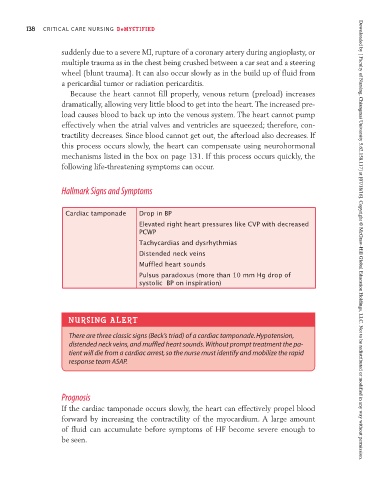
                             Cardiac tamponade    Drop in BP
                                                  Elevated right heart pressures like CVP with decreased
                                                  PCWP
                                                  Tachycardias and dysrhythmias                                 Downloaded by [ Faculty of Nursing, Chiangmai University 5.62.158.117] at [07/18/16]. Copyright © McGraw-Hill Global Education Holdings, LLC. Not to be redistributed or modified in any way without permission.
                                                  Distended neck veins
                                                  Muffled heart sounds
                                                  Pulsus paradoxus (more than 10 mm Hg drop of
                                                    systolic  BP on inspiration)


                              NURSING ALERT

                              There are three classic signs (Beck’s triad) of a cardiac tamponade. Hypotension,

                              distended neck veins, and muffled heart sounds. Without prompt treatment the pa-
                              tient will die from a cardiac arrest, so the nurse must identify and mobilize the rapid
                              response team ASAP.


                            Prognosis
                            If the cardiac tamponade occurs slowly, the heart can effectively propel blood
                            forward by increasing the contractility of the myocardium. A large amount
                            of fluid can accumulate before symptoms of HF become severe enough to
                            be seen.

