


Page 154 - Critical Care Nursing Demystified
P. 154
Chapter 3  CARE OF THE PATIENT WITH CRITICAL CARDIAC AND VASCULAR NEEDS        139


                                 If the tamponade develops quickly, as in the case of blunt or penetrating
                               trauma, a medical emergency can result unless pressure around the heart is
                               relieved ASAP.


                               Interpreting Test Results
                                 Echocardiogram can show fluid around the heart and compression of under-
                                 lying structures.
                                 ECG can show electrical alternans where one QRS is taller, alternating with
                                 a QRS that is shorter.
                                 Chext x-ray (CXR) shows fluid accumulation around the pericardial sac.


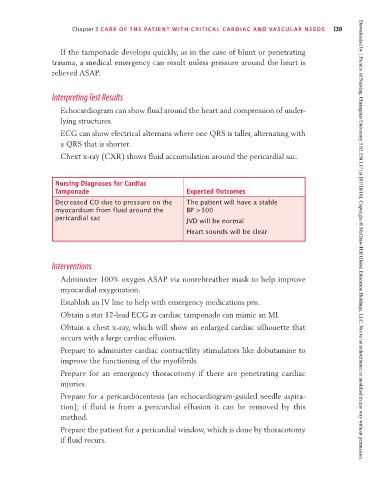
                               Nursing Diagnoses for Cardiac
                                 Tamponade                          Expected Outcomes
                               Decreased CO due to pressure on the   The patient will have a stable
                               myocardium from fluid around the     BP >100
                               pericardial sac                      JVD will be normal
                                                                    Heart sounds will be clear                      Downloaded by [ Faculty of Nursing, Chiangmai University 5.62.158.117] at [07/18/16]. Copyright © McGraw-Hill Global Education Holdings, LLC. Not to be redistributed or modified in any way without permission.


                               Interventions

                                 Administer 100% oxygen ASAP via nonrebreather mask to help improve
                                 myocardial oxygenation.
                                 Establish an IV line to help with emergency medications prn.
                                 Obtain a stat 12-lead ECG as cardiac tamponade can mimic an MI.
                                 Obtain a chest x-ray, which will show an enlarged cardiac silhouette that
                                 occurs with a large cardiac effusion.
                                 Prepare to administer cardiac contractility stimulators like dobutamine to
                                 improve the functioning of the myofibrils.
                                 Prepare for an emergency thoracotomy if there are penetrating cardiac
                                   injuries.
                                 Prepare for a pericardiocentesis (an echocardiogram-guided needle aspira-
                                 tion); if fluid is from a pericardial effusion it can be removed by this
                                 method.
                                 Prepare the patient for a pericardial window, which is done by thoracotomy
                                 if fluid recurs.

