


Page 175 - Critical Care Nursing Demystified
P. 175
160        CRITICAL CARE NURSING  DeMYSTIFIED


                     ANSWERS

                     CASE STUDY

                         1.   HTN, MI, gender, and race.
                         2.   Increased urination, persistent cough, 20-lb weight gain in 1 week, extreme fatigue and
                           SOB with exertion, feet and ankle edema.
                         3.   The BNP is the most definite, especially if it is greater than 400 pg/mL. Chest x-rays can
                           show pulmonary edema but not the cause. ABGs can indicate respiratory alkalosis in
                           the early stages and acidosis in the later stages. A decreased SaO  can confirm a drop
                                                                                  2
                           in oxygenation, but ABGs are more specific. An ECG can show nonspecific ST segment
                           elevation or MI changes (which can cause HF).
                         4.   He has signs and symptoms of biventricular failure. His SOB and persistent cough indi-
                           cate left (lung) involvement but his edema indicates right (peripheral).
                         5.   Decreased CO RT effects of high systemic pressure, pulmonary pressures AMB greater
                           than BP, cough, SOB, and peripheral edema. Ineffective gas exchange RT increased pul-
                           monary capillary pressure AMB cough and SOB.
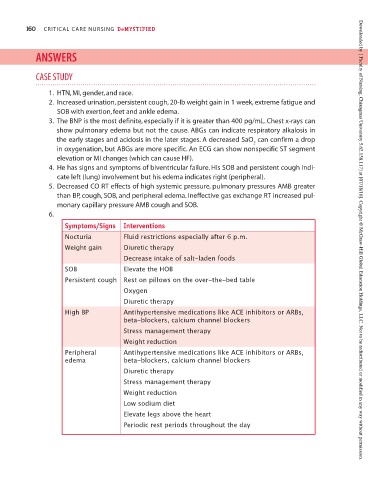
                         6.

                             Symptoms/Signs   Interventions
                             Nocturia         Fluid restrictions especially after 6 p.m.                        Downloaded by [ Faculty of Nursing, Chiangmai University 5.62.158.117] at [07/18/16]. Copyright © McGraw-Hill Global Education Holdings, LLC. Not to be redistributed or modified in any way without permission.
                             Weight gain      Diuretic therapy
                                              Decrease intake of salt-laden foods
                             SOB              Elevate the HOB
                             Persistent cough  Rest on pillows on the over-the-bed table
                                              Oxygen
                                              Diuretic therapy
                             High BP          Antihypertensive medications like ACE inhibitors or ARBs,
                                              beta-blockers, calcium channel blockers
                                              Stress management therapy
                                              Weight reduction
                             Peripheral       Antihypertensive medications like ACE inhibitors or ARBs,
                             edema            beta-blockers, calcium channel blockers
                                              Diuretic therapy
                                              Stress management therapy
                                              Weight reduction
                                              Low sodium diet
                                              Elevate legs above the heart
                                              Periodic rest periods throughout the day

