


Page 262 - Critical Care Nursing Demystified
P. 262
Chapter 5  CARE OF THE PATIENT WITH NEUROLOGICAL NEEDS        247


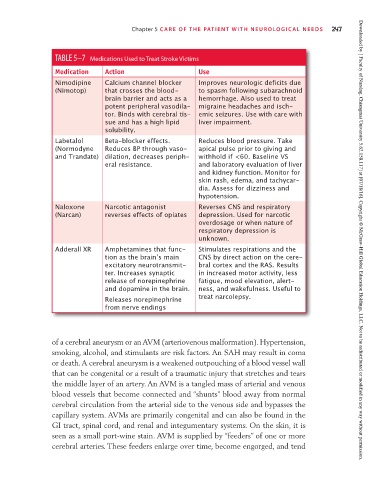
                               TABLE 5–7  Medications Used to Treat Stroke Victims
                               Medication    Action                     Use
                               Nimodipine    Calcium channel blocker    Improves neurologic deficits due
                                 (Nimotop)   that crosses the blood-    to spasm following subarachnoid
                                             brain barrier and acts as a   hemorrhage. Also used to treat
                                             potent peripheral vasodila-  migraine headaches and isch-
                                             tor. Binds with cerebral tis-  emic seizures. Use with care with
                                             sue and has a high lipid   liver impairment.
                                             solubility.
                               Labetalol     Beta-blocker effects.      Reduces blood pressure. Take
                               (Normodyne    Reduces BP through vaso-   apical pulse prior to giving and
                               and Trandate) dilation, decreases periph-  withhold if <60. Baseline VS
                                             eral resistance.           and laboratory evaluation of liver
                                                                        and kidney function. Monitor for
                                                                        skin rash, edema, and tachycar-
                                                                        dia. Assess for dizziness and
                                                                        hypotension.
                               Naloxone      Narcotic antagonist        Reverses CNS and respiratory
                               (Narcan)      reverses effects of opiates   depression. Used for narcotic
                                                                        overdosage or when nature of
                                                                        respiratory depression is
                                                                        unknown.                                    Downloaded by [ Faculty of Nursing, Chiangmai University 5.62.158.117] at [07/18/16]. Copyright © McGraw-Hill Global Education Holdings, LLC. Not to be redistributed or modified in any way without permission.
                               Adderall XR   Amphetamines that func-    Stimulates respirations and the
                                             tion as the brainʼs main   CNS by direct action on the cere-
                                             excitatory neurotransmit-  bral cortex and the RAS. Results
                                             ter. Increases synaptic    in increased motor activity, less
                                             release of norepinephrine   fatigue, mood elevation, alert-
                                             and dopamine in the brain.  ness, and wakefulness. Useful to
                                             Releases norepinephrine    treat narcolepsy.
                                             from nerve endings


                               of a cerebral aneurysm or an AVM (arteriovenous malformation). Hypertension,
                               smoking, alcohol, and stimulants are risk factors. An SAH may result in coma
                               or death. A cerebral aneurysm is a weakened outpouching of a blood vessel wall
                               that can be congenital or a result of a traumatic injury that stretches and tears
                               the middle layer of an artery. An AVM is a tangled mass of arterial and venous
                               blood vessels that become connected and “shunts” blood away from normal
                               cerebral circulation from the arterial side to the venous side and bypasses the
                               capillary system. AVMs are primarily congenital and can also be found in the
                               GI tract, spinal cord, and renal and integumentary systems. On the skin, it is
                               seen as a small port-wine stain. AVM is supplied by “feeders” of one or more
                               cerebral arteries. These feeders enlarge over time, become engorged, and tend

