


Page 264 - Critical Care Nursing Demystified
P. 264
Chapter 5  CARE OF THE PATIENT WITH NEUROLOGICAL NEEDS        249


                               Grade I            Asymptomatic, with a minimal headache and slight nuchal
                                                  rigidity
                               Grade II           Moderate to severe headache, nuchal rigidity, no neuro-
                                                  logic deficit other than cranial nerve palsy
                               Grade III          Drowsiness, confusion, or mild focal deficit
                               Grade IV           Stupor, moderate to severe hemiparesis, possible early
                                                  decerebrate rigidity, vegetative disturbances
                               Grade V            Deep coma, decerebrate rigidity, moribund appearance


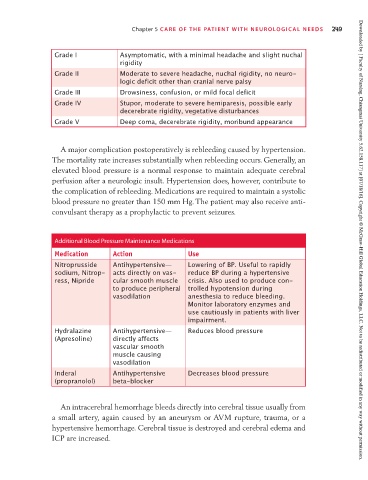
                                 A major complication postoperatively is rebleeding caused by hypertension.
                               The mortality rate increases substantially when rebleeding occurs. Generally, an
                               elevated blood pressure is a normal response to maintain adequate cerebral
                               perfusion after a neurologic insult. Hypertension does, however, contribute to
                               the complication of rebleeding. Medications are required to maintain a systolic
                               blood pressure no greater than 150 mm Hg. The patient may also receive anti-
                               convulsant therapy as a prophylactic to prevent seizures.


                               Additional Blood Pressure Maintenance Medications                                    Downloaded by [ Faculty of Nursing, Chiangmai University 5.62.158.117] at [07/18/16]. Copyright © McGraw-Hill Global Education Holdings, LLC. Not to be redistributed or modified in any way without permission.

                               Medication       Action               Use
                               Nitroprusside    Antihypertensive—    Lowering of BP. Useful to rapidly
                               sodium, Nitrop-  acts directly on vas-  reduce BP during a hypertensive
                               ress, Nipride    cular smooth muscle   crisis. Also used to produce con-
                                                to produce peripheral  trolled hypotension during
                                                vasodilation           anesthesia to reduce bleeding.
                                                                     Monitor laboratory enzymes and
                                                                     use  cautiously in patients with liver
                                                                     impairment.
                               Hydralazine      Antihypertensive—    Reduces blood pressure
                               (Apresoline)     directly affects
                                                  vascular smooth
                                                muscle causing
                                                  vasodilation
                               Inderal          Antihypertensive     Decreases blood pressure
                               (propranolol)    beta-blocker


                                 An intracerebral hemorrhage bleeds directly into cerebral tissue usually from
                               a small artery, again caused by an aneurysm or AVM rupture, trauma, or a
                               hypertensive hemorrhage. Cerebral tissue is destroyed and cerebral edema and
                               ICP are increased.

