


Page 272 - Critical Care Nursing Demystified
P. 272
Chapter 5  CARE OF THE PATIENT WITH NEUROLOGICAL NEEDS        257


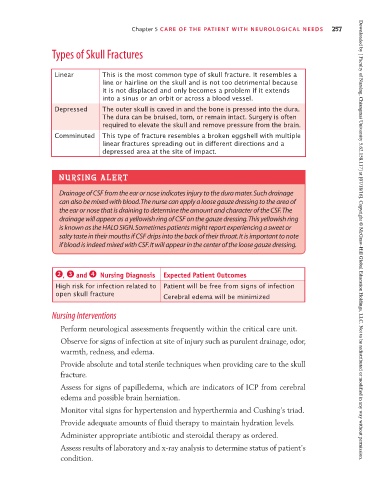
                               Types of Skull Fractures


                               Linear        This is the most common type of skull fracture. It resembles a
                                             line or hairline on the skull and is not too detrimental because
                                             it is not displaced and only becomes a problem if it extends
                                             into a sinus or an orbit or across a blood vessel.
                               Depressed     The outer skull is caved in and the bone is pressed into the dura.
                                             The dura can be bruised, torn, or remain intact. Surgery is often
                                             required to elevate the skull and remove pressure from the brain.
                               Comminuted  This type of fracture resembles a broken eggshell with multiple
                                             linear fractures spreading out in different directions and a
                                             depressed area at the site of impact.


                                 NURSING ALERT

                                 Drainage of CSF from the ear or nose indicates injury to the dura mater. Such drainage
                                 can also be mixed with blood. The nurse can apply a loose gauze dressing to the area of
                                 the ear or nose that is draining to determine the amount and character of the CSF. The
                                 drainage will appear as a yellowish ring of CSF on the gauze dressing. This yellowish ring
                                 is known as the HALO SIGN. Sometimes patients might report experiencing a sweet or
                                 salty taste in their mouths if CSF drips into the back of their throat. It is important to note   Downloaded by [ Faculty of Nursing, Chiangmai University 5.62.158.117] at [07/18/16]. Copyright © McGraw-Hill Global Education Holdings, LLC. Not to be redistributed or modified in any way without permission.
                                 if blood is indeed mixed with CSF. It will appear in the center of the loose gauze dressing.


                                2  ,   and    Nursing Diagnosis  Expected Patient Outcomes
                                          4
                                   3
                                High risk for infection related to  Patient will be free from signs of infection
                                open skull fracture           Cerebral edema will be minimized

                               Nursing Interventions
                                 Perform neurological assessments frequently within the critical care unit.

                                 Observe for signs of infection at site of injury such as purulent drainage, odor,
                                 warmth, redness, and edema.

                                 Provide absolute and total sterile techniques when providing care to the skull
                                 fracture.

                                 Assess for signs of papilledema, which are indicators of ICP from cerebral
                                 edema and possible brain herniation.

                                 Monitor vital signs for hypertension and hyperthermia and Cushing’s triad.
                                 Provide adequate amounts of fluid therapy to maintain hydration levels.
                                 Administer appropriate antibiotic and steroidal therapy as ordered.
                                 Assess results of laboratory and x-ray analysis to determine status of patient’s
                                 condition.

