


Page 344 - Critical Care Nursing Demystified
P. 344
Chapter 7  CARE OF THE PATIENT WITH ENDOCRINE DISORDERS        329


                               thyroid hormone and other medications that can compromise thyroid function.
                               Sufficient or insufficient dietary intake of iodine, intolerance to extreme changes
                               in environmental temperatures, visual problems, goiter or anterior neck enlarge-
                               ment, and family history of thyroid disease should also be explored. Determine
                               through questioning if the patient has had any changes in sleeping, elimination,
                               or eating patterns such as insomnia versus excessive sleeping, weight gain or
                               loss with increases or decreases in appetite, vomiting, diarrhea, or constipation.
                               Is the patient feeling overly anxious and restless or simply tired, fatigued, and
                               sluggish? Are there complaints of muscle weakness, tremors, heart palpitations,
                               or outbursts of crying and bad temper? Do they suffer from extreme sweating
                               and fever or has their skin, fingernails, and hair become dry, brittle, and scaly?
                                 Upon inspection the nurse will observe that a normal-sized thyroid gland is
                               not visibly obvious as a goiter or a bulge in front of the neck. Ask the patient to
                               swallow to see if upward movement of the thyroid gland is apparent. Observe
                               nutritional body mass, skin condition, emotional status, and signs of exophthal-
                               mus or bulging eyes. Evaluate diagnostic test results to determine increases or
                               decreases in T4 and T3 serum levels. Evaluate glucose results as hyperglycemia
                               can occur from an increase in nutrients minus a sufficient release of insulin.
                                 Assess vital signs through palpation and auscultation. Attention is given to       Downloaded by [ Faculty of Nursing, Chiangmai University 5.62.158.117] at [07/18/16]. Copyright © McGraw-Hill Global Education Holdings, LLC. Not to be redistributed or modified in any way without permission.
                               extreme highs or lows in body temperature and cardiac status such as tachy-
                               dysrhythmias and PVCs.
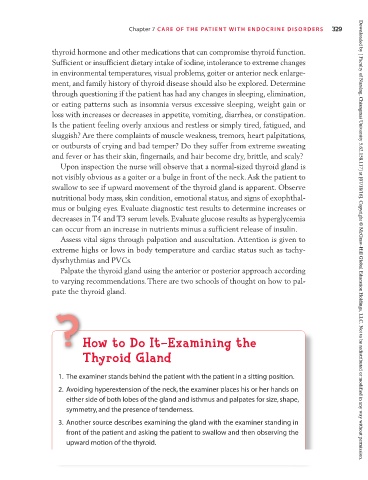
                                 Palpate the thyroid gland using the anterior or posterior approach according
                               to varying recommendations. There are two schools of thought on how to pal-
                               pate the thyroid gland.


                                       H ?  How to Do It—Examining the


                                                       o I
                                                 o D
                                          o
                                                           t—Ex
                                           w t
                                                                   a
                                       Thyroid Gland
                                       Thyroid Gland
                                1 .    T he examiner stands behind the patient
                                1.  The examiner stands behind the patient with the patient in a sitting position.
                                            y
                                                 t
                                                  ension of the neck,
                                                                   th
                                             per
                                               e
                                                x
                                2.  Avoiding hyperextension of the neck, the examiner places his or her hands on
                                2.
                                   A
                                           h
                                     oiding
                                    v
                                   either side of both lobes of the gland and isthmus and palpates for size, shape,
                                   either side o f  both lobes o f  the gland an
                                   symmetry, and the presence of tenderness.
                                   sy mm et ry  an dt h e  pr es en ce  o f  te nd er ne
                                3.  Another source describes examining the gland with the examiner standing in
                                   front of the patient and asking the patient to swallow and then observing the
                                   upward motion of the thyroid.

