


Page 341 - Critical Care Nursing Demystified
P. 341
326        CRITICAL CARE NURSING  DeMYSTIFIED


                            Intravenous thyroid hormone replacement and critical care management is nec-
                            essary for patient survival.


                            Prognosis
                            Intravenous thyroid hormone replacement and critical care management is nec-
                            essary for patient survival. The mortality rate is 20–25% even with vigorous
                            treatment and early intervention.


                            Hyperthyroidism (Graves’ Disease, Thyrotoxicosis)

                            What Went Wrong?
                            An excessive amount of thyroid hormone is produced and released beyond the
                            needs of the body. There is an increased metabolism level that can be caused
                            by tumors, inflammation, or autoimmune disorders of the thyroid gland.


                            Hallmark Signs and Symptoms
                            These include exophthalmus or large, bulging eyes; goiter; weight loss; extreme
                            irritability; nervousness; restlessness; and insomnia. The goal of care is to prevent
                            the oversecretion and adverse effects of thyroid hormones. Surgical intervention    Downloaded by [ Faculty of Nursing, Chiangmai University 5.62.158.117] at [07/18/16]. Copyright © McGraw-Hill Global Education Holdings, LLC. Not to be redistributed or modified in any way without permission.
                            such as a subtotal thyroidectomy, treatment with radioactive iodine, and anti-
                            thyroid medications are considered.
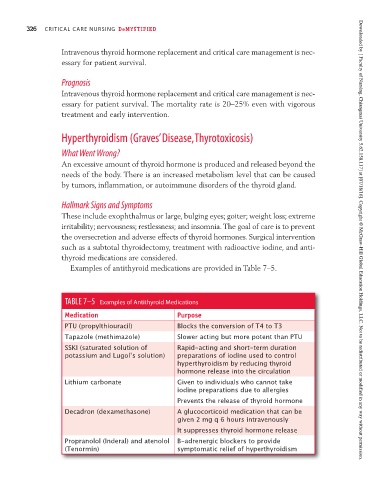
                               Examples of antithyroid medications are provided in Table 7–5.


                             TABLE 7–5  Examples of Antithyroid Medications
                             Medication                      Purpose
                             PTU (propylthiouracil)          Blocks the conversion of T4 to T3
                             Tapazole (methimazole)          Slower acting but more potent than PTU
                             SSKI (saturated solution of     Rapid-acting and short-term duration
                             potassium and Lugolʼs solution)   preparations of iodine used to control
                                                             hyperthyroidism by reducing thyroid
                                                             hormone release into the circulation
                             Lithium carbonate               Given to individuals who cannot take
                                                             iodine preparations due to allergies
                                                             Prevents the release of thyroid hormone
                             Decadron (dexamethasone)        A glucocorticoid medication that can be
                                                             given 2 mg q 6 hours intravenously
                                                             It suppresses thyroid hormone release
                             Propranolol (Inderal) and atenolol  B-adrenergic blockers to provide
                             (Tenormin)                      symptomatic relief of hyperthyroidism

