


Page 282 - Color_Atlas_of_Physiology_5th_Ed._-_A._Despopoulos_2003
P. 282
stimuli (! p. 170), whereas the release of me-  permeability of blood vessels (inflammation).
      latonin is subject to afferent neuron control  PGD 2 induces bronchoconstriction. PGI 2 (pros-
      (! p. 334).                     tacyclin) synthesized in the endothelium, is
        Some of these hormones (e.g., angiotensin  vasodilatory and inhibits platelet aggregation.
      II) and tissue hormones or mediators exert  TXA 2, on the other hand, occurs in platelets,
      paracrine effects within endocrine and ex-  promotes platelet aggregation and acts as a va-
      ocrine glands, the stomach wall, other organs,  soconstrictor (! p. 102). 11,12-EpETrE has a
      and on inflammatory processes. Bradykinin  vasodilatory effect (= EDHF, ! p. 214).
      (! pp. 214 and 236), histamine (! pp. 100
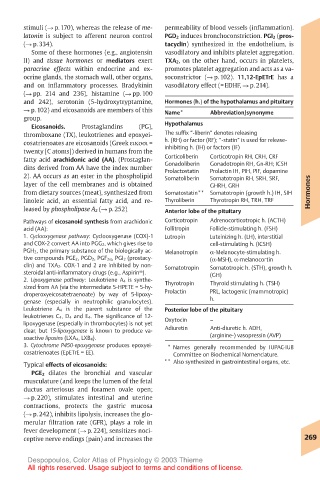
      and 242), serotonin (5-hydroxytryptamine,  Hormones (h.) of the hypothalamus and pituitary
      ! p. 102) and eicosanoids are members of this  Name*  Abbreviation/synonyme
      group.
        Eicosanoids.  Prostaglandins  (PG),  Hypothalamus
      thromboxane (TX), leukotrienes and epoxyei-  The suffix “-liberin” denotes releasing
      cosatrienoates are eicosanoids (Greek ει!%σι =  h. (RH) or factor (RF); “-statin” is used for release-
                                      inhibiting h. (IH) or factors (IF)
      twenty [C atoms]) derived in humans from the
      fatty acid arachidonic acid (AA). (Prostaglan-  Corticoliberin  Corticotropin RH, CRH, CRF
                                      Gonadoliberin
                                                Gonadotropin RH, Gn-RH; ICSH
      dins derived from AA have the index number  Prolactostatin  Prolactin IH, PIH, PIF, dopamine
      2). AA occurs as an ester in the phospholipid  Somatoliberin  Somatotropin RH, SRH, SRF,
      layer of the cell membranes and is obtained  GHRH, GRH
      from dietary sources (meat), synthesized from  Somatostatin**  Somatotropin (growth h.) IH, SIH  Hormones
      linoleic acid, an essential fatty acid, and re-  Thyroliberin  Thyrotropin RH, TRH, TRF
      leased by phospholipase A 2 (! p. 252) .  Anterior lobe of the pituitary
      Pathways of eicosanoid synthesis from arachidonic  Corticotropin  Adrenocorticotropic h. (ACTH)
      acid (AA):                      Follitropin  Follicle-stimulating h. (FSH)
      1. Cyclooxygenase pathway: Cyclooxygenase (COX)-1  Lutropin  Luteinizing h. (LH), interstitial
      and COX-2 convert AA into PGG 2, which gives rise to  cell-stimulating h. (ICSH)
      PGH 2, the primary substance of the biologically ac-  Melanotropin  α-Melanocyte-stimulating h.
      tive compounds PGE 2, PGD 2, PGF 2α, PGI 2 (prostacy-  (α-MSH), α-melanocortin
      clin) and TXA 2. COX-1 and 2 are inhibited by non-  Somatotropin  Somatotropic h. (STH), growth h.
      steroidal anti-inflammatory drugs (e.g., Aspirin!).  (GH)
      2. Lipoxygenase pathway: Leukotriene A 4 is synthe-  Thyrotropin  Thyroid stimulating h. (TSH)
      sized from AA (via the intermediate 5-HPETE = 5-hy-
      droperoxyeicosatetraenoate) by way of 5-lipoxy-  Prolactin  PRL, lactogenic (mammotropic)
      genase (especially in neutrophilic granulocytes).  h.
      Leukotriene A 4 is the parent substance of the  Posterior lobe of the pituitary
      leukotrienes C 4, D 4 and E 4. The significance of 12-  Oxytocin  –
      lipoxygenase (especially in thrombocytes) is not yet
      clear, but 15-lipoxygenase is known to produce va-  Adiuretin  Anti-diuretic h. ADH,
      soactive lipoxins (LXA 4, LXB 4).         (arginine-) vasopressin (AVP)
      3. Cytochrome P450-epoxygenase produces epoxyei-  ** Names generally recommended by IUPAC-IUB
      cosatrienoates (EpETrE = EE).     Committee on Biochemical Nomenclature.
      Typical effects of eicosanoids:  ** Also synthesized in gastrointestinal organs, etc.
        PGE 2 dilates the bronchial and vascular
      musculature (and keeps the lumen of the fetal
      ductus arteriosus and foramen ovale open;
      ! p. 220), stimulates intestinal and uterine
      contractions, protects the gastric mucosa
      (! p. 242), inhibits lipolysis, increases the glo-
      merular filtration rate (GFR), plays a role in
      fever development (! p. 224), sensitizes noci-
      ceptive nerve endings (pain) and increases the                  269

       Despopoulos, Color Atlas of Physiology © 2003 Thieme
       All rights reserved. Usage subject to terms and conditions of license.

