


Page 342 - Color_Atlas_of_Physiology_5th_Ed._-_A._Despopoulos_2003
P. 342
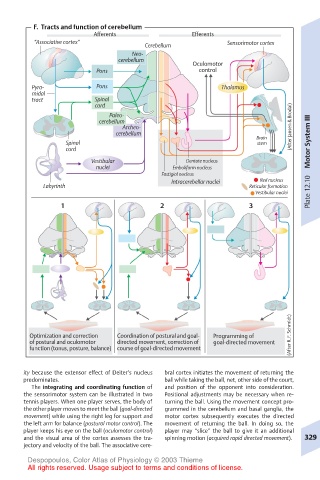
F.  Tracts and function of cerebellum
                      Afferents             Efferents
         “Associative cortex”                       Sensorimotor cortex
                                  Cerebellum
                               Neo-
                            cerebellum
                                            Oculomotor
                       Pons                   control
        Pyra-          Pons                        Thalamus
        midal
        tract         Spinal
                      cord
                          Paleo-
                       cerebellum
                             Archeo-                               (After Jansen & Brodal)
                           cerebellum                      Brain
                Spinal                                     stem        Motor System III
                cord
                      Vestibular           Dentate nucleus
                       nuclei           Emboliform nucleus
                                     Fastigial nucleus
                                        Intracerebellar nuclei             Red nucleus
           Labyrinth                                     Reticular formation
                                                          Vestibular nuclei  Plate 12.10
               1                     2                   3


        Optimization and correction  Coordination of postural and goal-  Programming of  (After R.F. Schmidt)
        of postural and oculomotor  directed movement, correction of  goal-directed movement
        function (tonus, posture, balance) course of goal-directed movement

      ity because the extensor effect of Deiter’s nucleus  bral cortex initiates the movement of returning the
      predominates.                   ball while taking the ball, net, other side of the court,
        The integrating and coordinating function of  and position of the opponent into consideration.
      the sensorimotor system can be illustrated in two  Positional adjustments may be necessary when re-
      tennis players. When one player serves, the body of  turning the ball. Using the movement concept pro-
      the other player moves to meet the ball (goal-directed  grammed in the cerebellum and basal ganglia, the
      movement) while using the right leg for support and  motor cortex subsequently executes the directed
      the left arm for balance (postural motor control). The  movement of returning the ball. In doing so, the
      player keeps his eye on the ball (oculomotor control)  player may “slice” the ball to give it an additional
      and the visual area of the cortex assesses the tra-  spinning motion (acquired rapid directed movement).  329
      jectory and velocity of the ball. The associative cere-
       Despopoulos, Color Atlas of Physiology © 2003 Thieme
       All rights reserved. Usage subject to terms and conditions of license.

