


Page 36 - Color_Atlas_of_Physiology_5th_Ed._-_A._Despopoulos_2003
P. 36
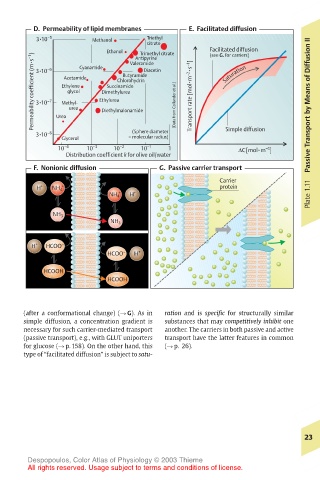
D.  Permeability of lipid membranes  E.  Facilitated diffusion
         3 •10 –5     Methanol    Triethyl
                                  citrate
                         Ethanol  Valeramide    Facilitated diffusion
                                Trimethyl citrate
                                                (see G. for carriers)
         Permeability coefficient (m •s –1 )  3 •10 –7  Ethylene  Ethylurea Chlorohydrin  (Data from Collander et al.)  Transport rate [mol •m –2 •s –1 ]  Saturation  Passive Transport by Means of Diffusion II
                               Antipyrine
                   Cyanamide
            –6
                                 Diacetin
         3•10
                             Butyramide
               Acetamide
                         Succinamide
                glycol
                        Dimethylurea
               Methyl-
                 urea
                        Diethylmalonamide
                               (Sphere diameter
         3 •10 –8  Urea         = molecular radius)  Simple diffusion
               Glycerol
              10 –4  10 –3  10 –2  10 –1  1            ∆C[mol •m ]
                                                             –3
                Distribution coefficient k for olive oil/water
         F.  Nonionic diffusion      G.  Passive carrier transport
                                                  Carrier
         H +      + NH 4 +                        protein
                            +
                          NH 4 +    H +                                Plate 1.11
             NH 3
                          NH 3
         +
        H + HCOO –
                             –
                         HCOO +    H +
           HCOOH
                         HCOOH
      (after a conformational change) (! G). As in  ration and is specific for structurally similar
      simple diffusion, a concentration gradient is  substances that may competitively inhibit one
      necessary for such carrier-mediated transport  another. The carriers in both passive and active
      (passive transport), e.g., with GLUT uniporters  transport have the latter features in common
      for glucose (! p. 158). On the other hand, this  (! p. 26).
      type of “facilitated diffusion” is subject to satu-


                                                                      23
                                                                      23
       Despopoulos, Color Atlas of Physiology © 2003 Thieme
       All rights reserved. Usage subject to terms and conditions of license.

