


Page 1021 - Hall et al (2015) Principles of Critical Care-McGraw-Hill
P. 1021
752     PART 5: Infectious Disorders


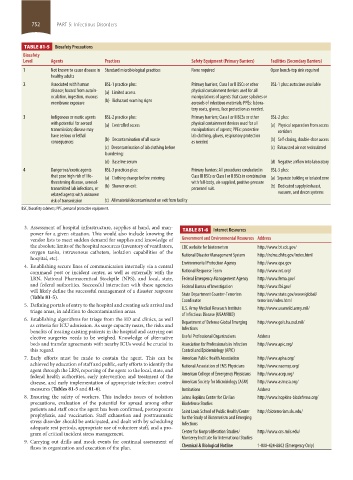
                   TABLE 81-5    Biosafety Precautions
                  Biosafety
                  Level    Agents             Practices                    Safety Equipment (Primary Barriers)  Facilities (Secondary Barriers)
                  1        Not known to cause disease in  Standard microbiological practices  None required  Open bench-top sink required
                           healthy adults
                  2        Associated with human   BSL-1 practice plus:    Primary barriers; Class I or II BSCs or other   BSL-1 plus: autoclave available
                           disease; hazard from autoin-  (a)  Limited access  physical containment devices used for all
                           oculation, ingestion, mucous                    manipulations of agents that cause splashes or
                           membrane exposure  (b)  Biohazard warning signs  aerosols of infectious materials; PPEs: labora-
                                                                           tory coats, gloves, face protection as needed.
                  3        Indigenous or exotic agents   BSL-2 practice plus:  Primary barriers; Class I or II BCSs or other   BSL-2 plus:
                           with potential for aerosol   (a)  Controlled access  physical containment devices used for all   (a)   Physical separation from access
                           transmission; disease may                       manipulations of agents; PPEs: protective   corridors
                           have serious or lethal                          lab clothing, gloves, respiratory protection
                             consequences     (b)  Decontamination of all waste  as needed            (b)  Self-closing, double-door access
                                              (c)  Decontamination of lab clothing before             (c)  Exhausted air not recirculated
                                              laundering;
                                              (d)  Baseline serum                                     (d)  Negative airflow into laboratory
                  4        Dangerous/exotic agents   BSL-3 practices plus:  Primary barriers: All procedures conducted in   BSL-3 plus:
                           that pose high risk of life-  (a)  Clothing change before entering  Class III BSCs or Class I or II BSCs in combination   (a)  Separate building or isolated zone
                           threatening disease, aerosol-                   with full-body, air-supplied, positive-pressure
                           transmitted lab infections, or   (b)  Shower on exit  personnel suit.      (b)   Dedicated supply/exhaust,
                           related agents with unknown                                                   vacuum, and decon systems
                           risk of transmission  (c)  All material decontaminated on exit from facility
                 BSC, biosafety cabinets; PPE, personal protective equipment.


                   3.  Assessment of hospital infrastructure, supplies at hand, and man-    TABLE 81-6    Internet Resources
                    power for a given situation. This would also include knowing the
                    vendor lists to meet sudden demand for supplies and knowledge of   Government and Environmental Resources Address
                    the absolute limits of the hospital resources (inventory of ventilators,   CDC website for bioterrorism  http://www.bt.cdc.gov/
                    oxygen tanks, intravenous catheters, isolation capabilities of the   National Disaster Management System  http://ndms.dhhs.gov/index.html
                    hospital, etc).
                   4.  Establishing secure lines of communication internally via a central   Environmental Protection Agency  http://www.epa.gov
                    command post or incident center, as well as externally with the   National Response Team  http://www.nrt.org/
                    LRN, National Pharmaceutical Stockpile (NPS), and local, state,   Federal Emergency Management Agency  http://www.fema.gov/
                    and federal authorities. Successful interaction with these agencies   Federal Bureau of Investigation  http://www.fbi.gov/
                    will likely define the successful management of a disaster response
                    (Table 81-5).                                       State Department Counter-Terrorism    http://www.state.gov/www/global/
                                                                        Coordinator               terrorism/index.html
                   5.  Defining portals of entry to the hospital and creating safe arrival and
                    triage areas, in addition to decontamination areas.  U.S. Army Medical Research Institute   http://www.usamriid.army.mil/
                                                                        of Infectious Disease (USAMRIID)
                   6.  Establishing algorithms for triage from the ED and clinics, as well
                    as criteria for ICU admission. As surge capacity nears, the risks and   Department of Defense Global Emerging   http://www.geis.ha.osd.mil/
                    benefits of treating existing patients in the hospital and carrying out   Infections
                    elective surgeries needs to be weighed. Knowledge of alternative   Useful Professional Organizations  Address
                    beds and transfer agreements with nearby ICUs would be crucial in   Association for Professionals in Infection   http://www.apic.org/
                    this regard.                                        Control and Epidemiology (APIC)
                   7.  Early  efforts  must  be  made  to  contain  the  agent.  This  can  be   American Public Health Association  http://www.apha.org/
                    achieved by education of staff and public, early efforts to identify the   National Association of EMS Physicians  http://www.naemsp.org/
                    agent through the LRN, reporting of the agent to the local, state, and
                    federal health authorities, early intervention and treatment of the   American College of Emergency Physicians  http://www.acep.org/
                    disease, and early implementation of appropriate infection control   American Society for Microbiology (ASM)  http://www.asmusa.org/
                    measures (Tables 81-5 and 81-6).                    Institutions              Address
                   8.  Ensuring the safety of workers. This includes issues of isolation   Johns Hopkins Center for Civilian   http://www.hopkins-biodefense.org/
                    precautions, evaluation of the potential for spread among other   Biodefense Studies
                    patients and staff once the agent has been confirmed, postexposure   Saint Louis School of Public Health/Center   http://bioterrorism.slu.edu/
                    prophylaxis, and vaccination. Staff exhaustion and posttraumatic   for the Study of Bioterrorism and Emerging
                    stress disorder should be anticipated, and dealt with by scheduling   Infections
                    adequate rest periods, appropriate use of volunteer staff, and a pro-
                    gram of critical incident stress management.        Center for Nonproliferation Studies/  http://www.cns.miis.edu/
                   9.  Carrying out drills and mock events for continual assessment of   Monterey Institute for International Studies
                    flaws in organization and execution of the plan.    Chemical & Biological Hotline  1-800-424-8802 (Emergency Only)


            section05_c74-81.indd   752                                                                                1/23/2015   12:37:46 PM

