


Page 1017 - Hall et al (2015) Principles of Critical Care-McGraw-Hill
P. 1017
748     PART 5: Infectious Disorders


                   Isolation of proven cases is not required since human-to-human   ensues. Progression to hypercapnic and secondary hypoxic respiratory
                 transmission does not occur. Standard precautions should be applied to   failure has been noted to occur within 24 hours in severe foodborne
                 care of patients with draining lesions or pneumonia. Decontamination   botulism. 37-39
                 of soiled linen and equipment can be done with heat and standard dis-  The diagnosis of botulism in the scenario of a bioterrorist attack
                 infectants. 34                                        should be made on the basis of its clinical and epidemiologic features
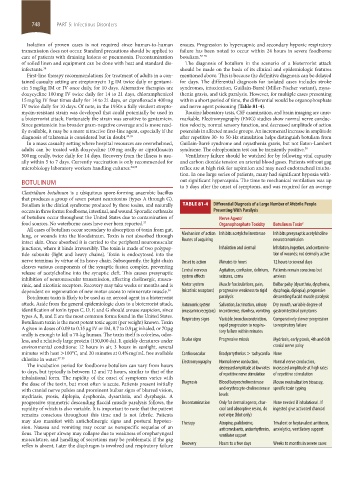
                   First-line therapy recommendations for treatment of adults in a con-  mentioned above. This is because the definitive diagnosis can be delayed
                 tained casualty setting are streptomycin 1 g IM twice daily or gentami-  for days. The differential diagnosis for isolated cases includes stroke
                 cin 5 mg/kg IM or IV once daily, for 10 days. Alternative therapies are   syndromes, intoxication, Guillain-Barré (Miller-Fischer variant), myas-
                 doxycycline 100 mg IV twice daily for 14 to 21 days, chloramphenicol   thenia gravis, and tick paralysis. However, for multiple cases presenting
                 15 mg/kg IV four times daily for 14 to 21 days, or ciprofloxacin 400 mg   within a short period of time, the differential would be organophosphate
                 IV twice daily for 10 days. Of note, in the 1950s a fully virulent strepto-  and nerve agent poisoning (Table 81-4).
                 mycin-resistant strain was developed that could potentially be used in   Routine laboratory tests, CSF examination, and brain imaging are unre-
                 a bioterrorist attack. Fortunately the strain was sensitive to gentamicin.   markable. Electromyography (EMG) studies show normal nerve conduc-
                 Since gentamicin has broader gram-negative coverage and is more read-  tion velocity, normal sensory function, and decreased amplitude of action
                 ily available, it may be a more attractive first-line agent, especially if the   potentials in affected muscle groups. An incremental increase in amplitude
                 diagnosis of tularemia is considered but in doubt. 34,35  after repetitive 30- to 50-Hz stimulation helps distinguish botulism from
                   In a mass casualty setting where hospital resources are overwhelmed,   Guillain-Barré syndrome and myasthenia gravis, but not Eaton-Lambert
                 adults can be treated with doxycycline 100 mg orally or ciprofloxacin   syndrome. The edrophonium test can be transiently positive. 39
                 500 mg orally, twice daily for 14 days. Recovery from the illness is usu-  Ventilatory failure should be watched for by following vital capacity
                 ally within 5 to 7 days. Currently vaccination is only recommended for   and carbon dioxide tension on arterial blood gases. Patients without gag
                 microbiology laboratory workers handling cultures. 34,35  reflex are at high risk for aspiration and may need endotracheal intuba-
                                                                       tion. In one large series of patients, many had significant hypoxia with-
                 BOTULINUM                                             out significant hypercapnia. The time to mechanical ventilation was up
                                                                       to 5 days after the onset of symptoms, and was required for an average
                 Clostridium botulinum is a ubiquitous spore-forming anaerobic bacillus
                 that produces a group of seven potent neurotoxins (types A through G).
                 Botulism is the clinical syndrome produced by these toxins, and naturally     TABLE 81-4     Differential Diagnosis of a Large Number of Afebrile People
                 occurs in three forms: foodborne, intestinal, and wound. Sporadic outbreaks   Presenting With Paralysis
                 of botulism occur throughout the United States due to  contamination of   Nerve Agent/
                 food sources. No waterborne cases have ever been reported. 37       Organophosphate Toxicity  Botulinum Toxin 2
                   All cases of botulism occur secondary to absorption of toxin from gut,
                 lung, or wounds into the bloodstream. Toxin is not absorbed through   Mechanism of action  Inhibits acetylcholinesterase  Inhibits presynaptic acetylcholine
                 intact skin. Once absorbed it is carried to the peripheral neuromuscular   Routes of acquiring  neurotransmission
                 junctions, where it binds irreversibly. The toxin is made of two polypep-  Inhalation and dermal  Inhalation, ingestion, and contamina-
                 tide  subunits  (light  and  heavy  chains).  Toxin is  endocytosed  into  the        tion of wounds; not dermally active
                 nerve terminus by virtue of its heavy chain. Subsequently, the light chain   Onset to action  Minutes to hours  12 hours to several days
                 cleaves various components of the synaptic fusion complex, preventing
                 release of acetylcholine into the synaptic cleft. This causes presynaptic   Central nervous   Agitation, confusion, delirium,  Patients remain conscious but
                 inhibition of neuromuscular transmission, affecting cholinergic, musca-    system effects  seizures, coma  anxious
                 rinic, and nicotinic receptors. Recovery may take weeks or months and is   Motor system   Muscle fasciculations, pain,   Bulbar palsy (dysarthria, dysphonia,
                 dependent on regeneration of new motor axons to reinnervate muscle. 38  ( nicotinic receptors) progressive weakness to rigid  dysphagia, diplopia), progressive
                   Botulinum toxin is likely to be used as an aerosol agent in a bioterrorist   paralysis  descending flaccid muscle paralysis
                 attack. Aside from the general epidemiologic clues to a bioterrorist attack,   Autonomic system   Salivation, lacrimation, urinary   Dry mouth, variable degree of
                 identification of toxin types C, D, F, and G should arouse suspicion, since   (muscarinic receptors) incontinence, diarrhea, vomiting  gastrointestinal symptoms
                 types A, B, and E are the most common forms found in the United States.
                 Botulinum toxin is the most potent toxic agent (per weight) known. Toxin   Respiratory signs  Variable bronchoconstriction,   Comparatively slower progression
                                                                                     rapid progression to respira-
                                                                                                       to respiratory failure
                 A given in doses of 0.09 to 0.15 μg IV or IM, 0.7 to 0.9 μg inhaled, or 70 μg
                 orally is enough to kill a 70-kg human. The toxin itself is colorless, odor-  tory failure within minutes
                 less, and a relatively large protein (150,000 da). It quickly denatures under   Ocular signs  Progressive miosis  Mydriasis, early ptosis, 4th and 6th
                 environmental conditions: 12 hours in air, 3 hours in sunlight, several               cranial nerve palsy
                 minutes with heat >100°C, and 20 minutes at 0.4% mg/mL free available   Cardiovascular  Bradyarrythmias > tachycardia None
                 chlorine in water. 37-39                               Electromyography  Normal nerve conduction,   Normal nerve conduction,
                   The incubation period for foodborne botulism can vary from hours   decreased amplitude at low rates  increased amplitude at high rates
                 to days, but typically is between 12 and 72 hours, similar to that of the   of repetitive nerve stimulation  of repetitive stimulation
                 inhalational form. The rapidity of the onset of symptoms varies with
                 the dose of the toxin, but most often is acute. Patients present initially   Diagnosis  Blood butyrocholinesterase   Mouse neutralization bioassay,
                 with cranial nerve palsies and prominent bulbar signs of blurred vision,   and erythrocyte-cholinesterase   specific toxin typing
                 mydriasis,  ptosis,  diplopia, dysphonia,  dysarthria, and dysphagia.  A   levels
                 progressive symmetric descending flaccid muscle paralysis follows, the   Decontamination  Only for dermal agents, char-  None needed if inhalational. If
                 rapidity of which is also variable. It is important to note that the patient   coal and absorptive resins, do  ingested give activated charcoal
                 remains  conscious  throughout  this time and  is not  febrile.  Patients   not wipe (blot only)
                 may also manifest with anticholinergic signs and postural hypoten-  Therapy  Atropine, pralidoxime,   Trivalent or heptavalent antitoxin,
                 sion. Nausea and vomiting may occur as nonspecific sequelae of an     anticonvulsants, antiarrhythmics,  anxiolytics, ventilatory support
                 ileus. The upper airway may collapse due to weakness of oropharyngeal     ventilator support
                 musculature, and handling of secretions may be problematic if the gag
                 reflex is absent. Later the diaphragm is involved and respiratory failure   Recovery  Hours to a few days  Weeks to months in severe cases


            section05_c74-81.indd   748                                                                                1/23/2015   12:37:45 PM

