


Page 813 - Hall et al (2015) Principles of Critical Care-McGraw-Hill
P. 813
544     PART 5: Infectious Disorders


                   CHAPTER   Principles of Antimicrobial               a low V  and therefore are greatly affected by these fluid shifts. Since
                                                                             d
                                                                         lipophilic antimicrobials have a larger V , they typically distribute further
                                                                                                   d
                    61       Therapy and the Clinical                  into tissues and are less affected by these fluid shifts. Patients in the
                                                                       ICU often have hypotension as a result of septic shock, which requires
                             Pharmacology of                           the administration of fluid boluses. Additionally, heart failure and renal
                             Antimicrobial Drugs                       failure lead to more edematous states where patients can retain large
                                                                       amounts of fluid. These situations also lead to increases in V  of hydro-
                                                                                                                   d
                                                                       philic drugs. Changes in protein binding can also have a substantial
                             Amira Ashok Bhalodi                       effect on the V , especially for drugs that are highly protein bound. Only
                             David P. Nicolau                                     d
                                                                       unbound or free drug is microbiologically active. Hypoalbuminemia
                                                                       in critically ill patients can result in decreased binding of drugs and
                                                                       subsequently higher free concentrations of drugs. While free drug will
                  KEY POINTS
                                                                       distribute into tissues, critically ill patients often have greater amounts
                     • The altered pharmacokinetics of critically ill patients can greatly   of fluid in the interstitial space causing the antimicrobial concentrations
                    impact antimicrobial exposures. Recognizing these changes and   in the tissues to remain low. 3
                    optimizing  antimicrobial  administration  to  make  certain  appro-  The administration of large volumes of fluid and use of vasopressors
                    priate pharmacodynamic targets are reached is crucial in ensuring   leads to a hypermetabolic state in which cardiac output and glomerular
                    successful outcomes.                               filtration rate are increased. It has been shown in animal studies that
                     • Understanding the impact of the MIC of the pathogen on overall    increases in cardiac output result in increases in renal blood flow. The
                    free-drug exposures is important to be able to reach required   term often used to describe this enhanced elimination is augmented
                                                                                   4
                    pharmacodynamic targets of efficacy. Ultimately, organisms with   renal clearance.  These physiological changes affect the clearance of
                    high MICs will require a larger free-drug exposure compared with   drugs and can lead to subtherapeutic levels of antimicrobials that
                    organisms with lower MICs.                         are typically cleared renally. In contrast, decreased organ perfusion
                     • Patients with augmented renal function will exhibit enhanced clear-  in the presence of end organ damage can lead to kidney and/or liver
                                                                       failure in which concentrations of these antimicrobials would be
                    ance of antimicrobials, particularly β-lactams, and are at risk for   increased. Inadequate clearance or metabolism of these drugs would
                    subtherapeutic exposures. Therefore, these patients often require   lead to   accumulation and potential toxicity. Typically, equations such
                    higher doses and more frequent administration of the antimicrobial.  as Cockroft-Gault are used to estimate renal function; however, these
                     • Antimicrobial stewardship focused on disease state management   are often not good predictors of renal function in critically ill patients
                    and selecting the appropriate antimicrobial therapy for the infect-  due to the acute and rapid changes such patients often experience. Since
                    ing pathogen is essential in preventing poor outcomes. In addition   many antimicrobials are dosed based on renal function it is even more
                    to poor outcomes, failure to treat infections appropriately can lead   challenging to ensure adequate doses are being administered. The most
                    to the emergence of resistant organisms that become increasingly   accurate way to calculate renal function is the use of 8- or 12-hour
                    difficult to treat.                                creatinine collections.  In situations where renal replacement therapy
                                                                                       2
                     • Given  the  vast  majority  of  antimicrobials  are  renally  cleared,   is utilized, careful consideration of timing and supplemental dosing
                    concentrations of antimicrobials are affected by continuous renal   post-dialysis would be needed depending on the antimicrobial agent.
                    replacement therapy and therefore dosing should be modified   Understanding  the pharmacokinetics factors that affect drug  con-
                    accordingly to obtain adequate target exposures.   centrations is essential in ensuring drugs are delivered to the target
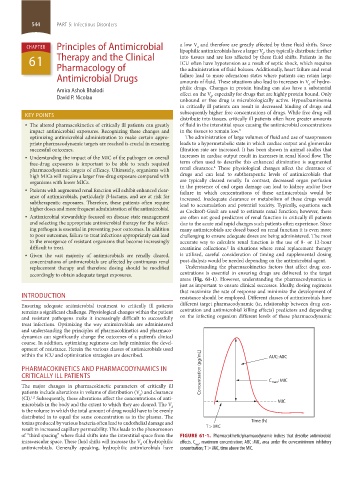
                                                                       areas (Fig. 61-1). However, understanding the pharmacodynamics is
                                                                       just as important to ensure clinical successes. Ideally, dosing regimens
                                                                       that maximize the rate of response and minimize the development of
                 INTRODUCTION                                          resistance should be employed. Different classes of antimicrobials have
                 Ensuring adequate antimicrobial treatment to critically ill patients   different target pharmacodynamic (ie, relationship between drug con-
                 remains a significant challenge. Physiological changes within the patient   centration and antimicrobial killing effects) predictors and depending
                 and resistant pathogens make it increasingly difficult to successfully   on the infecting organism different levels of these pharmacodynamic
                 treat infections. Optimizing the way antimicrobials are administered
                 and understanding the principles of pharmacokinetics and pharmaco-
                 dynamics can significantly change the outcomes of a patient’s clinical
                 course. In addition, optimizing regimens can help minimize the devel-
                 opment of resistance. Herein the various classes of antimicrobials used
                 within the ICU and optimization strategies are described.                            AUC: MIC

                 PHARMACOKINETICS AND PHARMACODYNAMICS IN
                 CRITICALLY ILL PATIENTS                                      Concentration ( g/mL)   C  : MIC
                 The major changes in pharmacokinetic parameters of critically ill                    max
                 patients include alterations in volume of distribution (V ) and clearance
                                                         d
                 (Cl).  Subsequently, these alterations affect the concentrations of anti-
                     1,2
                 microbials in the body and the extent to which they are cleared. The V                  MIC
                                                                    d
                 is the volume in which the total amount of drug would have to be evenly
                 distributed in to equal the same concentration as in the plasma. The
                 toxins produced by various bacteria often lead to endothelial damage and      Time (h)
                 result in increased capillary permeability. This leads to the phenomenon   T > MIC
                 of “third spacing” where fluid shifts into the interstitial space from the   FIGURE 61-1.  Pharmacokinetic/pharmacodynamic indices that describe antimicrobial
                 intravascular space. These fluid shifts will increase the V  of hydrophilic   effects. C , maximum concentration; AUC : MIC, area under the curve:minimum inhibitory
                                                          d
                                                                            max
                 antimicrobials. Generally speaking, hydrophilic antimicrobials have   concentration; T > MIC, time above the MIC.


            section05_c61-73.indd   544                                                                                1/23/2015   12:47:12 PM

