


Page 817 - Hall et al (2015) Principles of Critical Care-McGraw-Hill
P. 817
548     PART 5: Infectious Disorders

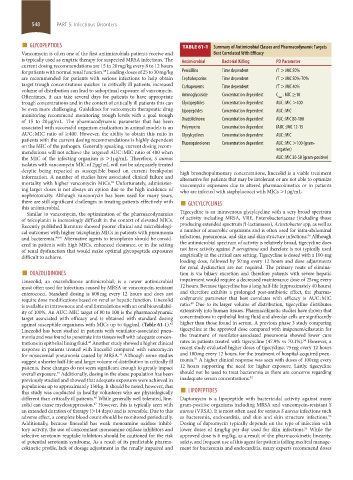
                     ■  GLYCOPEPTIDES                                    TABLE 61-1     Summary of Antimicrobial Classes and Pharmacodynamic Targets

                 Vancomycin is often one of the first antimicrobials patients receive and   Best Correlated With Efficacy
                 is typically used as empiric therapy for suspected MRSA infections. The   Antimicrobial  Bacterial Killing  PD Parameter
                 current dosing recommendations are 15 to 20 mg/kg every 8 to 12 hours
                 for patients with normal renal function.  Loading doses of 25 to 30 mg/kg     Penicillins  Time dependent  fT > MIC 50%
                                             38
                 are  recommended  for  patients  with  serious  infections  to  help  obtain   Cephalosporins  Time dependent  fT > MIC 50%-70%
                 target trough concentrations quicker. In critically ill patients, increased   Carbapenems  Time dependent  fT > MIC 40%
                 volume of distribution can lead to suboptimal exposure of vancomycin.
                 Oftentimes, it can take several days for patients to have appropriate   Aminoglycoside  Concentration dependent  C  : MIC ≥10
                                                                                                         max
                 trough concentrations and in the context of critically ill patients this can   Glycopeptides  Concentration dependent  AUC : MIC >400
                 be even more challenging. Guidelines for vancomycin therapeutic drug   Lipopeptides  Concentration dependent  AUC : MIC
                 monitoring recommend monitoring trough levels with a goal trough
                 of 15 to 20 µg/mL. The pharmacodynamic parameter that has been   Oxazolidinone  Concentration dependent  AUC : MIC 80-100
                 associated with successful organism eradication in animal models is an   Polymyxins  Concentration dependent  fAUC : MIC 12-15
                 AUC : MIC ratio of ≥400. However, the ability to obtain this ratio in   Glycylcyclines  Concentration dependent  AUC : MIC
                 patients with the current dosing recommendations is highly dependent
                 on the MIC of the pathogen. Generally speaking, current dosing recom-  Fluoroquinolones  Concentration dependent  AUC : MIC >100 (gram-
                 mendations will not achieve the targeted AUC : MIC ratio of 400 when                   negative)
                 the MIC of the infecting organism is  >1 µg/mL.  Therefore,  S aureus                  AUC : MIC 30-50 (gram-positive)
                 isolates with vancomycin MIC of 2 µg/mL will not be adequately treated
                 despite being reported as susceptible based on current breakpoint   high bronchopulmonary concentrations, linezolid is a viable treatment
                 information. A number of studies have associated clinical failure and   alternative for patients that may be intolerant or are not able to optimize
                 mortality with higher vancomycin MICs.  Unfortunately, administer-  vancomycin exposures due to altered pharmacokinetics or in patients
                                                39
                 ing larger doses is not always an option due to the high incidence of   who are infected with staphylococci with MICs >1 µg/mL.
                 nephrotoxicity. Although vancomycin has been used for many years,
                 there are still significant challenges in treating patients effectively with     ■  GLYCYLCYCLINES
                 this antimicrobial.
                   Similar to vancomycin, the optimization of the pharmacodynamics   Tigecycline is an intravenous glycylcycline with a very broad spectrum
                 of teicoplanin is increasingly difficult in the context of elevated MICs.   of activity including MRSA, VRE, Enterobacteriaceae (including those
                 Recently published literature showed poorer clinical and microbiologi-  producing extended spectrum β-lactamases), Acinetobacter spp, as well as
                 cal outcomes with higher teicoplanin MICs in patients with pneumonia   a number of anaerobic organisms and is often used for intra-abdominal
                                                                                                                   48
                 and bacteremia. 40,41  Alternative agents to teicoplanin should be consid-  infections, pneumonia, and skin and skin structure infections.  Although
                 ered in patients with high MICs, enhanced clearance, or in the setting   the antimicrobial spectrum of activity is relatively broad, tigecycline does
                 of renal dysfunction that would make optimal glycopeptide exposures   not have activity against P aeruginosa and therefore is not typically used
                 difficult to achieve.                                 empirically in the critical care setting. Tigecycline is dosed with a 100-mg
                                                                       loading dose, followed by 50 mg every 12 hours and dose adjustments
                     ■  OXAZOLIDINONES                                 for renal dysfunction are not required. The primary route of elimina-
                                                                       tion is via biliary excretion and therefore patients with severe hepatic
                 Linezolid, an oxazolidinone antimicrobial, is a newer antimicrobial   impairment would require a decreased maintenance dose of 25 mg every
                 most often used for infections caused by MRSA or vancomycin-resistant   12 hours. Because tigecycline has a long half-life (approximately 40 hours)
                 enterococci. Standard dosing is 600 mg every 12 hours and does not   and therefore exhibits a prolonged post- antibiotic effect, the pharma-
                 require dose modifications based on renal or hepatic function. Linezolid   codynamic parameter that best correlates with efficacy is AUC : MIC
                                                                           49
                 is available in intravenous and oral formulations with an oral bioavailabil-  ratio.  Due to its larger volume of distribution, tigecycline distributes
                 ity of 100%. An AUC : MIC target of 80 to 100 is the pharmacodynamic   extensively into human tissues. Pharmacokinetic studies have shown that
                 target associated with  efficacy  and is  obtained with standard  dosing   concentrations in epithelial lining fluid and alveolar cells are significantly
                 against susceptible organisms with MICs up to 4 µg/mL (Table 61-1).    higher than those found in serum. A previous phase 3 study comparing
                                                                    42
                 Linezolid has been studied in patients with ventilator-associated pneu-  tigecycline at the approved dose compared with imipenem/cilastatin for
                 monia and was found to penetrate into tissues well with adequate concen-  the treatment of ventilator-associated pneumonia showed lower cure
                                                                                                                 50
                 trations in epithelial lining fluid.  Another study showed a higher clinical   rates in patients treated with tigecycline (47.9% vs 70.1%).  However, a
                                        43
                 response in patients treated with linezolid compared with vancomycin   recent study evaluated higher doses of tigecycline, 75 mg every 12 hours
                 for nosocomial pneumonia caused by MRSA.  Although some studies   and 100 mg every 12 hours, for the treatment of hospital-acquired pneu-
                                                  44
                                                                            51
                 suggest a shorter half-life and larger volume of distribution in critically ill   monia.  A higher clinical response was seen with doses of 100 mg every
                 patients, these changes do not seem significant enough to greatly impact   12 hours supporting the need for higher exposure. Lastly, tigecycline
                 overall exposure.  Additionally, dosing in the obese population has been   should not be used to treat bacteremia as there are concerns regarding
                             45
                 previously studied and showed that adequate exposures were achieved in   inadequate serum concentrations. 52
                 this study was conducted in healthy volunteers who are physiologically   ■  LIPOPEPTIDES
                 populations up to approximately 150 kg. It should be noted, however, that
                 different than critically ill patients.  While generally well tolerated, line-  Daptomycin is a lipopeptide with bactericidal activity against many
                                          46
                 zolid can cause myelosuppression.  However, this is typically seen with   gram-positive organisms including MRSA and vancomycin-resistant S
                                          47
                 an extended duration of therapy (>14 days) and is reversible. Due to this   aureus (VRSA). It is most often used for serious S aureus infections such
                 adverse effect, a complete blood count should be monitored periodically.   as bacteremia, endocarditis, and skin and skin structure infections.
                                                                                                                          53
                 Additionally, because linezolid has weak monoamine oxidase inhibi-  Dosing of daptomycin typically depends on the type of infection with
                 tory activity, the use of concomitant monoamine oxidase inhibitors and   lower doses of 4mg/kg per day used for skin infections.  While the
                                                                                                                  54
                 selective serotonin reuptake inhibitors should be cautioned for the risk   approved dose is 6 mg/kg, as a result of the pharmacokinetic linearity,
                 of potential serotonin syndrome. As a result of its predictable pharma-  safety, and frequent use of this agent for patients failing medical manage-
                 cokinetic profile, lack of dosage adjustment in the renally impaired and   ment for bacteremia and endocarditis, many experts recommend doses


            section05_c61-73.indd   548                                                                                1/23/2015   12:47:13 PM

