


Page 889 - Hall et al (2015) Principles of Critical Care-McGraw-Hill
P. 889
620     PART 5: Infectious Disorders


                                                                       self-contained hospital nursing units outfitted with high-efficiency
                                                                       particulate air filtration (HEPA) has reduced the incidence of invasive
                                                                       aspergillosis  and overall mortality rates.  Guidelines are available for
                                                                                426
                                                                                                     427
                                                                       planning  infection  control  strategies  where  hospital  maintenance  and
                                                                       renovation projects are underway. 428-430  HEPA-filtered nursing units have
                                                                       lower concentrations of airborne fungal conidia than their non-HEPA-
                                                                       filtered counterparts.  Despite these observations, a meta-analysis of
                                                                                       431
                                                                       the impact of HEPA-filtered protected environments failed to detect a
                                                                       mortality benefit in neutropenic or nonneutropenic patients.  A recent
                                                                                                                   432
                                                                       systematic  review  did  observe  a  treatment  effect  for  preventing  the
                                                                       development of “all-cause” pulmonary infiltrates. 433
                                                                         Invasive aspergillosis has high mortality rates regardless of treatment.
                                                                                                                         434
                                                                       The risk of this infection increases with the duration of neutropenia to
                                                                       a plateau of 70% to 80% at 5 weeks  particularly in environments with
                                                                                                 435
                                                                       high degrees of contamination with mold conidia.  Marrow recovery is
                                                                                                           436
                                                                       the most important factor relating to survival. 437
                                                                         The clinical findings relate to the infected organ site. Fever is almost
                                                                       invariably present. Evidence of tissue ischemia and infarction may pro-
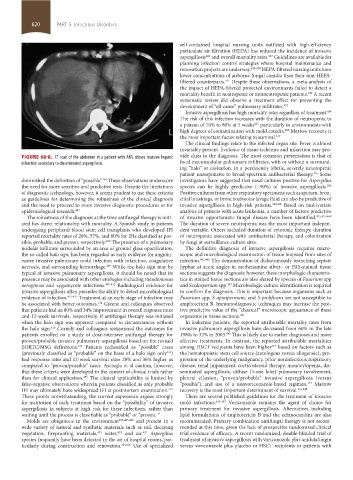
                 FIGURE 68-8.  CT scan of the abdomen in a patient with AML shows massive hepatic   vide clues to the diagnosis. The most common presentation is that of
                 infarction secondary to disseminated aspergillosis.   focal macronodular pulmonary infiltrates, with or without a surround-
                                                                       ing “halo” or cavitation, in a persistently febrile, severely neutropenic
                                                                       patient unresponsive to broad-spectrum antibacterial therapy.  Some
                                                                                                                     416
                 diminished the definition of “possible”.  These observations underscore   investigators have suggested that nasal cultures positive for Aspergillus
                                             406
                 the need for more sensitive and predictive tests. Despite the limitations   species can be highly predictive (~90%) of invasive aspergillosis.
                                                                                                                         286
                 of diagnostic technology, however, it seems prudent to use these criteria   Positive cultures from other respiratory specimens such as sputum, bron-
                 as guidelines for determining the robustness of the clinical diagnosis   chial brushings, or bronchoalveolar lavage fluid can also be predictive of
                 and the need to proceed to more invasive diagnostic procedures or for   invasive aspergillosis in high-risk patients. 346,406  Based on multivariate
                 epidemiological research. 407                         analysis of patients with acute leukemia, a number of factors predictive
                   The robustness of the diagnosis at the time antifungal therapy is initi-  of invasive opportunistic fungal disease have been identified. 435,437-440
                 ated has direct relationship with mortality. A Spanish study in patients   The duration of severe neutropenia was the most important indepen-
                 undergoing peripheral blood stem cell transplants who developed IFI   dent variable. Others included duration of cytotoxic therapy, duration
                 reported mortality rates of 20%, 57%, and 80% for IFIs classified as pos-  of neutropenia associated with antibacterial therapy, and colonization
                 sible, probable, and proven, respectively.  The presence of a pulmonary   by fungi at surveillance culture sites.
                                              408
                 nodular infiltrate surrounded by an area of ground glass opacification,   The  definitive  diagnosis  of  invasive  aspergillosis  requires  micro-
                 the so-called halo sign, has been regarded as early evidence for angioin-  scopic and microbiological examination of tissue biopsied from sites of
                 vasive invasive pulmonary mold infection with infarction, coagulative   infection. 403,406  The demonstration of dichotomously branching septate
                 necrosis, and surrounding hemorrhage.  While the halo sign may be   hyphae at acute angles in methenamine silver– or PAS-stained tissue
                                              409
                 typical of invasive pulmonary aspergillosis, it should be noted that its   sections suggests the diagnosis; however, these morphologic characteris-
                 presence may be associated with other etiologies including Pseudomonas   tics in stained tissue sections are also shared by species of Fusarium spp
                 aeruginosa and zygomycete infections. 409-412  Radiological evidence for   and Scedosporium spp.  Microbiologic culture identification is required
                                                                                       403
                 invasive aspergillosis often precedes the ability to detect microbiological   to confirm the diagnosis. This is important because organisms such as
                 evidence of infection. 413-415  Treatment at an early stage of infection may   Fusarium spp, S apiospermum, and S prolificans are not susceptible to
                 be associated with better outcomes.  Greene and colleagues observed   amphotericin B. Immunodiagnostic techniques may increase the posi-
                                           134
                 that patients had an 80% and 34% improvement in overall response rates   tive predictive value of the “classical” microscopic appearance of these
                 and 12-week survivals, respectively, if antifungal therapy was initiated   organisms in tissue sections. 441
                 when the halo sign was apparent compared to circumstances without   In leukemia patients, the reported attributable mortality rates from
                 the halo sign.  Cornely and colleagues reexamined the outcomes for   invasive pulmonary aspergillosis have decreased from 60% in the late
                           416
                 patients enrolled on a study of dose-intensive antifungal therapy for   1980s to 32% in 2003.  This is likely due to earlier diagnoses and more
                                                                                       442
                 proven/probable invasive pulmonary aspergillosis based on the revised   effective  treatments.  In  contrast,  the  reported  attributable  mortalities
                 EORTC/MSG definitions.  Patients reclassified as “possible” cases   among HSCT recipients have been higher  based on factors such as
                                    417
                                                                                                      443
                 (previously classified as “probable” on the basis of a halo sign only )   the hematopoietic stem cell source (autologous versus allogeneic), pro-
                                                                   418
                 had response rates and 12-week survival rates 28% and 36% higher as   gression of the underlying malignancy, prior noninfectious respiratory
                 compared to “proven/possible” cases. Ascioglu et al caution, however,   disease, renal impairment, corticosteroid therapy, monocytopenia, dis-
                 that these criteria were developed in the context of clinical trials rather   seminated aspergillosis, diffuse (>one lobe) pulmonary involvement,
                 than for clinical application.  The clinical applicability is limited by   pleural effusion, “proven/probable” invasive aspergillosis (versus
                                      405
                 false-negative observations wherein patients classified as only probable   “possible”),  and use of a nonvoriconazole-based regimen.  Marrow
                                                                                                                   444
                 IFI may ultimately have widespread IFI at postmortem examination.    recovery is the most important determinant of survival. 437,444
                                                                   419
                 These points notwithstanding, the current experience argues strongly   There are several published guidelines for the treatment of invasive
                 for institution of early treatment based on the “possibility” of invasive   mold infections. 445-447  Voriconazole remains the agent of choice for
                 aspergillosis in subjects at high risk for these infections, rather than   primary treatment for invasive aspergillosis. Alternatives including
                 waiting until the process is classifiable as “probable” or “proven. ”  lipid formulations of amphotericin B and the echinocandins are also
                   Molds are ubiquitous in the environment 293,403,420  and present in a   recommended. Primary combination antifungal therapy is not recom-
                 wide variety of natural and synthetic materials such as soil, decaying   mended at this time, given the lack of prospective randomized clinical
                 vegetation, fireproofing materials,  water,  and air.   Aspergillus   trial evidence of efficacy. A recent randomized, double-blinded trial of
                                                          423
                                                  422
                                           421
                 species frequently have been detected in the air of hospital rooms, par-  treatment of invasive aspergillosis with voriconozole plus anidulafungin
                 ticularly during construction and renovation. 424,425  Use of specialized   versus voriconazole plus placebo in HSCT recipients or patients with


            section05_c61-73.indd   620                                                                                1/23/2015   12:48:11 PM

