


Page 888 - Hall et al (2015) Principles of Critical Care-McGraw-Hill
P. 888
CHAPTER 68: Approach to Infection in Patients Receiving Cytotoxic Chemotherapy for Malignancy       619


                                                                           Molds produce similar syndromes in compromised hosts, including
                                                                          necrotizing nasal mucosal infection, sinusitis, endophthalmitis, cerebral
                                                                          parenchymal infection, pulmonary parenchymal infection, cutaneous
                                                                          infection, typhlitis, hepatosplenic abscesses, osteomyelitis, and intravas-
                                                                          cular infections. 402
                                                                           Infections by these molds are characterized by blood vessel invasion
                                                                          resulting in thrombosis, which, in turn, causes ischemia and infarc-
                                                                          tion of distal tissues. 292,293,403,404  This is the mechanism for the clinical
                                                                          manifestations such as pulmonary cavitary disease, hemoptysis, cutane-
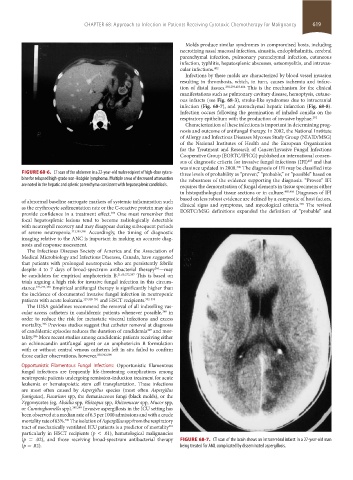
                                                                          ous infarcts (see Fig. 68-3), stroke-like syndromes due to intracranial
                                                                          infection (Fig. 68-7), and parenchymal hepatic infarction (Fig. 68-8).
                                                                          Infection occurs following the germination of inhaled conidia on the
                                                                          respiratory epithelium with the production of invasive hyphae. 292
                                                                           Characterization of these infections is important in determining prog-
                                                                          nosis and outcome of antifungal therapy. In 2002, the National Institute
                                                                          of Allergy and Infectious Diseases Mycoses Study Group (NIAID/MSG)
                                                                          of the National Institutes of Health and the European Organization
                                                                          for the Treatment and Research of Cancer/Invasive Fungal Infections
                                                                          Cooperative Group (EORTC/IFICG) published an international consen-
                                                                          sus of diagnostic criteria for invasive fungal infections (IFI)  and that
                                                                                                                     405
                                                                          was since updated in 2008.  The diagnosis of IFI may be classified into
                                                                                             406
                    FIGURE 68-6.  CT scan of the abdomen in a 22-year-old male recipient of high-dose cytara-  three levels of probability as “proven,” “probable,” or “possible” based on
                    bine for relapsed high-grade non-Hodgkin lymphoma. Multiple areas of decreased attenuation   the robustness of the evidence supporting the diagnosis. “Proven” IFI
                    are noted in the hepatic and splenic parenchyma consistent with hepatosplenic candidiasis.  requires the demonstration of fungal elements in tissue specimens either
                                                                          in histopathological tissue sections or in culture. 405,406  Diagnoses of IFI
                                                                          based on less robust evidence are defined by a composite of host factors,
                    of abnormal baseline surrogate markers of systemic inflammation such   clinical signs and symptoms, and mycological  criteria.  The  revised
                                                                                                                  405
                    as the erythrocyte sedimentation rate or the C-reactive protein may also
                    provide confidence in a treatment effect.  One must remember that   EORTC/MSG definitions expanded the definition of “probable” and
                                                  384
                    focal  hepatosplenic  lesions tend to become radiologically  detectable
                    with neutrophil recovery and may disappear during subsequent periods
                    of  severe  neutropenia. 373,385,386   Accordingly,  the  timing  of  diagnostic
                    imaging relative to the ANC is important in making an accurate diag-
                    nosis and response assessment.
                     The Infectious Diseases Society of America and the Association of
                    Medical Microbiology and Infectious Diseases, Canada, have suggested
                    that patients with prolonged neutropenia who are persistently febrile
                    despite 4 to 7 days of broad-spectrum antibacterial therapy —may
                                                                 266
                    be candidates for empirical amphotericin B. 21,65,272,387  This is based on
                    trials arguing a high risk for invasive fungal infection in this circum-
                    stance. 273,274,388  Empirical antifungal therapy is significantly higher than
                    the incidence of documented invasive fungal infection in neutropenic
                    patients with acute leukemia. 119,389-391  and HSCT recipients. 392-395
                     The IDSA guidelines recommend the removal of all indwelling vas-
                    cular access catheters in candidemic patients whenever possible,  in
                                                                    349
                    order to reduce the risk for metastatic visceral infections and excess
                    mortality.  Previous studies suggest that catheter removal at diagnosis
                           396
                    of candidemic episodes reduces the duration of candidemia  and mor-
                                                              397
                    tality.  More recent studies among candidemic patients receiving either
                        396
                    an echinocandin antifungal agent or an amphotericin B formulation
                    with or without central venous catheters left in situ failed to confirm
                    those earlier observations, however. 350,362,398
                    Opportunistic Filamentous Fungal Infections:  Opportunistic filamentous
                    fungal infections are frequently life-threatening complications among
                    neutropenic patients undergoing remission-induction treatment for acute
                    leukemia or hematopoietic stem cell transplantation. These infections
                    are most often caused by  Aspergillus species (most often  Aspergillus
                    fumigatus), Fusarium spp, the dematiaceous fungi (black molds), or the
                    Zygomycetes (eg, Absidia spp, Rhizopus spp, Rhizomucor spp, Mucor spp,
                    or Cunninghamella spp). 345,399  Invasive aspergillosis in the ICU setting has
                    been observed at a median rate of 6.3 per 1000 admissions and with a crude
                    mortality rate of 63%.  The isolation of Aspergillus spp from the respiratory
                                  400
                                                                      401
                    tract of mechanically ventilated ICU patients is a predictor of mortality
                    particularly in HSCT recipients (p  <  .01), hematological malignancies
                    (p  = .02), and those receiving broad-spectrum antibacterial therapy       FIGURE 68-7.  CT scan of the brain shows an intracerebral infarct in a 27-year-old man
                    (p = .02).                                            being treated for AML complicated by disseminated aspergillosis.


            section05_c61-73.indd   619                                                                                1/23/2015   12:48:11 PM

