


Page 158 - Psychology of Wounds and Wound Care in Clinical Practice ( PDFDrive )
P. 158
Pressure Ulcers  133


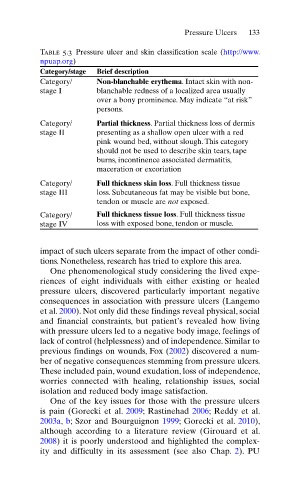
                Table 5.3   Pressure ulcer and skin classification scale (  http://www.
           npuap.org     )
            Category/stage    Brief description
                                             .
            Category/      Non-blanchable erythema  Intact skin with non-
           stage I      blanchable redness of a localized area usually
                        over a bony prominence. May indicate “at risk”
                        persons.
                                     .
            Category/      Partial thickness  Partial thickness loss of dermis
           stage II     presenting as a shallow open ulcer with a red
                        pink wound bed, without slough. This category
                        should not be used to describe skin tears, tape
                        burns, incontinence associated dermatitis,
                        maceration or excoriation
                                          .
            Category/      Full thickness skin loss  Full thickness tissue
           stage III    loss. Subcutaneous fat may be visible but bone,
                        tendon or muscle are  not  exposed.
                                           .
            Category/      Full thickness tissue loss  Full thickness tissue
           stage IV     loss with exposed bone, tendon or muscle.

           impact of such ulcers separate from the impact of other condi-
           tions. Nonetheless, research has tried to explore this area.
                   One phenomenological study considering the lived expe-
           riences of eight individuals with either existing or healed
             pressure ulcers, discovered particularly important negative
           consequences in association with pressure ulcers (Langemo
           et al.   2000 ). Not only did these findings reveal physical, social
           and financial constraints, but patient’s revealed how living
           with pressure ulcers led to a negative body image, feelings of
           lack of control (helplessness) and of independence. Similar to
           previous findings on wounds, Fox (  2002 ) discovered a num-
           ber of negative consequences stemming from pressure ulcers.
           These included pain, wound exudation, loss of independence,
           worries connected with healing, relationship issues, social
           isolation and reduced body image satisfaction.
              One of the key issues for those with the pressure ulcers
           is pain (Gorecki et al.   2009 ; Rastinehad  2006 ; Reddy et al.
             2003a ,  b ; Szor and Bourguignon  1999 ; Gorecki et al.  2010 ),
           although according to a literature review (Girouard et al.
             2008 ) it is poorly understood and highlighted the complex-
           ity and difficulty in its assessment (see also Chap.    2    ).  PU

