


Page 157 - Psychology of Wounds and Wound Care in Clinical Practice ( PDFDrive )
P. 157
132  Chapter 5.  Different Wound Type


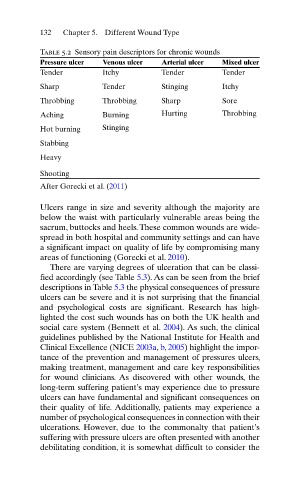
              Table 5.2   Sensory pain descriptors for chronic wounds
            Pressure ulcer    Venous ulcer    Arterial ulcer    Mixed ulcer
            Tender         Itchy         Tender        Tender
            Sharp          Tender        Stinging      Itchy

            Throbbing      Throbbing     Sharp         Sore
            Aching         Burning       Hurting       Throbbing
            Hot burning    Stinging
            Stabbing
            Heavy

            Shooting
               After Gorecki et al. (  2011 )

           Ulcers range in size and severity although the majority are
           below the waist with particularly vulnerable areas being the
           sacrum, buttocks and heels. These common wounds are wide-
           spread in both hospital and community settings and can have
           a significant impact on quality of life by compromising many
           areas of functioning (Gorecki et al.   2010 ).
              There are varying degrees of ulceration that can be classi-
           fied accordingly (see Table   5.3 ). As can be seen from the brief
           descriptions in Table   5.3  the physical consequences of pressure
           ulcers can be severe and it is not surprising that the financial
           and psychological costs are significant. Research has high-
           lighted the cost such wounds has on both the UK health and
           social care system (Bennett et al.   2004 ). As such, the clinical
           guidelines published by the National Institute for Health and
           Clinical Excellence (NICE   2003a ,  b ,  2005 ) highlight the impor-
           tance of the prevention and management of pressures ulcers,
           making treatment, management and care key responsibilities
           for wound clinicians.  As discovered with other wounds, the
           long-term suffering patient’s may experience due to pressure
           ulcers can have fundamental and significant consequences on
           their quality of life. Additionally, patients may experience a
           number of psychological consequences in connection with their
           ulcerations. However, due to the commonalty that patient’s
           suffering with pressure ulcers are often presented with another
           debilitating condition, it is somewhat difficult to consider the

