


Page 219 - Psychology of Wounds and Wound Care in Clinical Practice ( PDFDrive )
P. 219
194  Chapter 8.  Family, Friends and Social Support

           (Sarason et al.  1983 ). There is a distinction between the exis-
           tence of social relationships and the functions provided by
           these. That is, the structure would be based on ‘how many
           friends, colleagues, or family relationships’ you have and the
           functional aspect would refer to what these do.
              Essentially you can have lots of friends but have no inter-
           action with them which is not useful to us. Social support can
           come from a variety of different sources and a variety of
           types of support (Cohen et al.   2000 ), for instance, spouses,
           relatives, friends, neighbours, co-workers, or superiors. But it
           can also come from professional sources (e.g. the nurse or
           other health care professional) and this can help in reducing
           stress, thus becoming a useful and advantageous social inter-
           action. The type and amount of social support an individual
           receives depends upon their social network but also on vari-
           ous demographic factors such as their age, sex, culture, socio-
           economic status and so on.
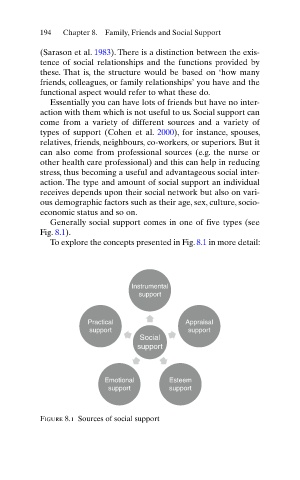
              Generally social support comes in one of five types (see
           Fig.   8.1 ).
                To explore the concepts presented in Fig.   8.1  in more detail:


                                 Instrumental
                                  support


                      Practical               Appraisal
                      support                 support
                                   Social
                                  support


                          Emotional       Esteem
                           support        support


             Figure 8.1     Sources of social support

