


Page 245 - Psychology of Wounds and Wound Care in Clinical Practice ( PDFDrive )
P. 245
220  Chapter 9.  Conclusion

           The presence of these factors, along with immobility, social
           isolation, pain, mood disorders and other psychosocial factors
           not only exacerbates their severity and jeopardises their abil-
           ity to heal but also could lead to further wounds occurrence.
           Of course, there are some protective factors and these can
           include not only positive and appropriate clinical wound care
           but also psychosocial factors.
               Each of these factors, whether positive or negative, has
           been described, evidenced and reported in this book. This
           final chapter will emphasise the clinical relevance of the
           material presented and provide some simple implications for
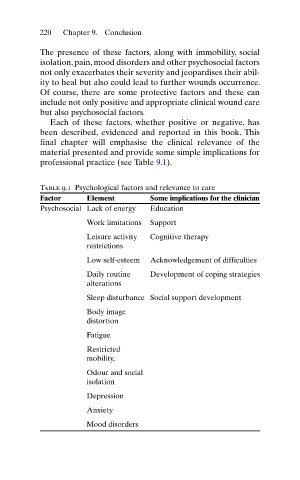
           professional practice (see Table   9.1 ).


                 Table 9.1   Psychological factors and relevance to care
            Factor     Element         Some implications for the clinician
            Psychosocial   Lack of energy    Education
                       Work limitations   Support
                       Leisure activity    Cognitive therapy
                      restrictions

                        Low self-esteem     Acknowledgement of difficulties
                       Daily routine     Development of coping strategies
                      alterations
                        Sleep disturbance   Social support development
                       Body image
                      distortion
                       Fatigue
                       Restricted
                      mobility,

                        Odour and social
                      isolation
                       Depression
                       Anxiety
                       Mood disorders

