


Page 343 - Clinical Anatomy
P. 343
ECA5  7/18/06  6:51 PM  Page 328


                 328  The head and neck


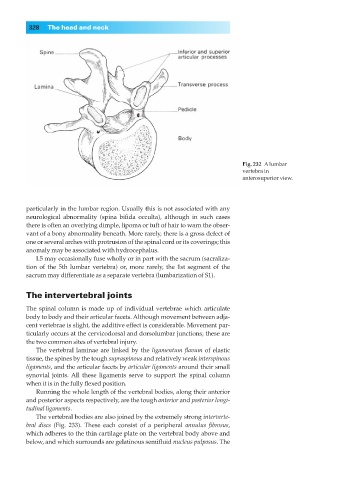
                                                                              Fig. 232◊Alumbar
                                                                              vertebra in
                                                                              anterosuperior view.


                particularly in the lumbar region. Usually this is not associated with any
                neurological abnormality (spina bifida occulta), although in such cases
                there is often an overlying dimple, lipoma or tuft of hair to warn the obser-
                vant of a bony abnormality beneath. More rarely, there is a gross defect of
                one or several arches with protrusion of the spinal cord or its coverings; this
                anomaly may be associated with hydrocephalus.
                   L5 may occasionally fuse wholly or in part with the sacrum (sacraliza-
                tion of the 5th lumbar vertebra) or, more rarely, the 1st segment of the
                sacrum may differentiate as a separate vertebra (lumbarization of S1).

                The intervertebral joints

                The spinal column is made up of individual vertebrae which articulate
                body to body and their articular facets. Although movement between adja-
                cent vertebrae is slight, the additive effect is considerable. Movement par-
                ticularly occurs at the cervicodorsal and dorsolumbar junctions; these are
                the two common sites of vertebral injury.
                   The vertebral laminae are linked by the ligamentum flavum of elastic
                tissue, the spines by the tough supraspinous and relatively weak interspinous
                ligaments, and the articular facets by articular ligaments around their small
                synovial joints. All these ligaments serve to support the spinal column
                when it is in the fully flexed position.
                   Running the whole length of the vertebral bodies, along their anterior
                and posterior aspects respectively, are the tough anterior and posterior longi-
                tudinal ligaments.
                   The vertebral bodies are also joined by the extremely strong interverte-
                bral discs (Fig. 233). These each consist of a peripheral  annulus fibrosus,
                which adheres to the thin cartilage plate on the vertebral body above and
                below, and which surrounds are gelatinous semifluid nucleus pulposus. The

