


Page 352 - Clinical Anatomy
P. 352
ECA6  7/18/06  6:54 PM  Page 337


                                                                             The spinal cord   337


                                        below the lesion; proprioception and fine touch are preserved till late in the
                                        uncrossed posterior columns.
                                        3◊◊Hemisection of the cord is followed by the  Brown-Séquard syndrome;
                                        there is paralysis on the affected side below the lesion (pyramidal tract) and
                                        also loss of proprioception and fine discrimination (dorsal columns). Pain
                                        and temperature senses are lost on the  opposite side below the lesion,
                                        because the affected spinothalamic tract carries fibres which have decus-
                                        sated below the level of cord hemisection.
                                        4◊◊Tabes dorsalis, which is a syphilitic degenerative lesion of the posterior
                                        columns and posterior nerve roots, is characterized by loss of propriocep-
                                        tion; the patient becomes ataxic, particularly if he closes his eyes, because
                                        he has lost his position sense for which he can partially compensate by
                                        visual knowledge of his spatial relationship (Romberg’s sign).
                                        5◊◊Intractable pain can be treated in selected cases by cutting the appropri-
                                        ate posterior nerve roots (posterior rhizotomy) or by division of the
                                        spinothalamic tract on the side opposite the pain (cordotomy). A knife
                                        passed 3mm into the cord anterior to the denticulate ligament and then
                                        swept anteriorly from this point will sever the spinothalamic tract but pre-
                                        serve the pyramidal tract lying immediately posterior to it.


                                        The membranes of the cord (the meninges)
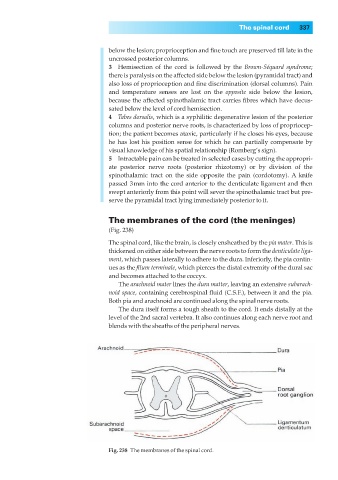
                                        (Fig. 238)

                                        The spinal cord, like the brain, is closely ensheathed by the pia mater. This is
                                        thickened on either side between the nerve roots to form the denticulate liga-
                                        ment, which passes laterally to adhere to the dura. Inferiorly, the pia contin-
                                        ues as the filum terminale, which pierces the distal extremity of the dural sac
                                        and becomes attached to the coccyx.
                                          The arachnoid mater lines the dura matter, leaving an extensive subarach-
                                        noid space, containing cerebrospinal fluid (C.S.F.), between it and the pia.
                                        Both pia and arachnoid are continued along the spinal nerve roots.
                                          The dura itself forms a tough sheath to the cord. It ends distally at the
                                        level of the 2nd sacral vertebra. It also continues along each nerve root and
                                        blends with the sheaths of the peripheral nerves.


                                        Fig. 238◊The membranes of the spinal cord.

