


Page 369 - Clinical Anatomy
P. 369
ECA6  7/18/06  6:54 PM  Page 354


                 354  The central nervous system


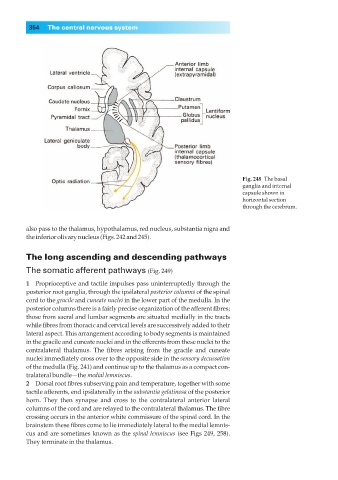
                                                                              Fig. 248◊The basal
                                                                              ganglia and internal
                                                                              capsule shown in
                                                                              horizontal section
                                                                              through the cerebrum.


                also pass to the thalamus, hypothalamus, red nucleus, substantia nigra and
                the inferior olivary nucleus (Figs. 242 and 245).

                The long ascending and descending pathways

                The somatic afferent pathways (Fig. 249)
                1◊◊Proprioceptive and tactile impulses pass uninterruptedly through the
                posterior root ganglia, through the ipsilateral posterior columns of the spinal
                cord to the gracile and cuneate nuclei in the lower part of the medulla. In the
                posterior columns there is a fairly precise organization of the afferent fibres;
                those from sacral and lumbar segments are situated medially in the tracts
                while fibres from thoracic and cervical levels are successively added to their
                lateral aspect. This arrangement according to body segments is maintained
                in the gracile and cuneate nuclei and in the efferents from these nuclei to the
                contralateral thalamus. The fibres arising from the gracile and cuneate
                nuclei immediately cross over to the opposite side in the sensory decussation
                of the medulla (Fig. 241) and continue up to the thalamus as a compact con-
                tralateral bundle—the medial lemniscus.
                2◊◊Dorsal root fibres subserving pain and temperature, together with some
                tactile afferents, end ipsilaterally in the substantia gelatinosa of the posterior
                horn. They then synapse and cross to the contralateral anterior lateral
                columns of the cord and are relayed to the contralateral thalamus. The fibre
                crossing occurs in the anterior white commissure of the spinal cord. In the
                brainstem these fibres come to lie immediately lateral to the medial lemnis-
                cus and are sometimes known as the spinal lemniscus (see Figs 249, 258).
                They terminate in the thalamus.

