


Page 365 - Clinical Anatomy
P. 365
ECA6  7/18/06  6:54 PM  Page 350


                 350  The central nervous system


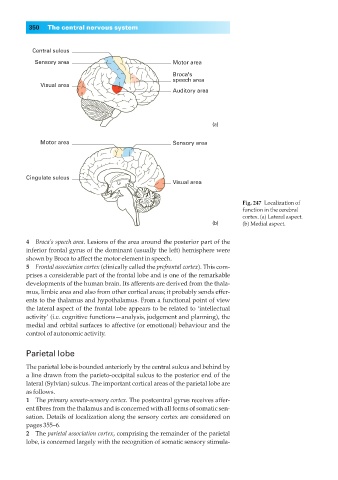
                 Central sulcus
                  Sensory area                            Motor area

                                                          Broca's
                                                          speech area
                    Visual area
                                                          Auditory area


                                                                     (a)


                    Motor area                            Sensory area


                Cingulate sulcus
                                                          Visual area


                                                                              Fig. 247◊Localization of
                                                                              function in the cerebral
                                                                              cortex. (a) Lateral aspect.
                                                                     (b)      (b) Medial aspect.


                4◊◊Broca’s speech area. Lesions of the area around the posterior part of the
                inferior frontal gyrus of the dominant (usually the left) hemisphere were
                shown by Broca to affect the motor element in speech.
                5◊◊Frontal association cortex (clinically called the prefrontal cortex). This com-
                prises a considerable part of the frontal lobe and is one of the remarkable
                developments of the human brain. Its afferents are derived from the thala-
                mus, limbic area and also from other cortical areas; it probably sends effer-
                ents to the thalamus and hypothalamus. From a functional point of view
                the lateral aspect of the frontal lobe appears to be related to ‘intellectual
                activity’ (i.e. cognitive functions—analysis, judgement and planning), the
                medial and orbital surfaces to affective (or emotional) behaviour and the
                control of autonomic activity.


                Parietal lobe
                The parietal lobe is bounded anteriorly by the central sulcus and behind by
                a line drawn from the parieto-occipital sulcus to the posterior end of the
                lateral (Sylvian) sulcus. The important cortical areas of the parietal lobe are
                as follows.
                1◊◊The primary somato-sensory cortex. The postcentral gyrus receives affer-
                ent fibres from the thalamus and is concerned with all forms of somatic sen-
                sation. Details of localization along the sensory cortex are considered on
                pages 355–6.
                2◊◊The parietal association cortex, comprising the remainder of the parietal
                lobe, is concerned largely with the recognition of somatic sensory stimula-

