


Page 20 - Critical Care Notes
P. 20
4223_Tab01_001-044  29/08/14  10:46 AM  Page 14


           BASICS

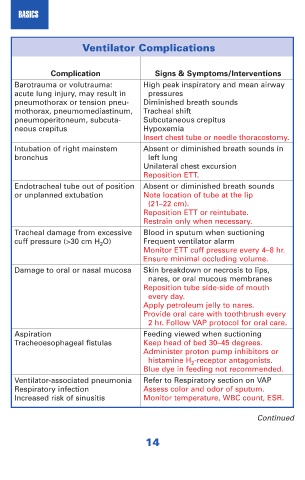
                      Ventilator Complications

                 Complication     Signs & Symptoms/Interventions
           Barotrauma or volutrauma:  High peak inspiratory and mean airway
           acute lung injury, may result in  pressures
           pneumothorax or tension pneu-  Diminished breath sounds
           mothorax, pneumomediastinum,  Tracheal shift
           pneumoperitoneum, subcuta-  Subcutaneous crepitus
           neous crepitus       Hypoxemia
                                Insert chest tube or needle thoracostomy.
           Intubation of right mainstem   Absent or diminished breath sounds in
           bronchus              left lung
                                Unilateral chest excursion
                                Reposition ETT.
           Endotracheal tube out of position  Absent or diminished breath sounds
           or unplanned extubation  Note location of tube at the lip
                                 (21–22 cm).
                                Reposition ETT or reintubate.
                                Restrain only when necessary.
           Tracheal damage from excessive   Blood in sputum when suctioning
           cuff pressure (>30 cm H 2 O)  Frequent ventilator alarm
                                Monitor ETT cuff pressure every 4–8 hr.
                                Ensure minimal occluding volume.
           Damage to oral or nasal mucosa  Skin breakdown or necrosis to lips,
                                 nares, or oral mucous membranes
                                Reposition tube side-side of mouth
                                 every day.
                                Apply petroleum jelly to nares.
                                Provide oral care with toothbrush every
                                 2 hr. Follow VAP protocol for oral care.
           Aspiration           Feeding viewed when suctioning
           Tracheoesophageal fistulas  Keep head of bed 30–45 degrees.
                                Administer proton pump inhibitors or
                                 histamine H 2 -receptor antagonists.
                                Blue dye in feeding not recommended.
           Ventilator-associated pneumonia  Refer to Respiratory section on VAP
           Respiratory infection  Assess color and odor of sputum.
           Increased risk of sinusitis  Monitor temperature, WBC count, ESR.
                                                   Continued
                                14

