


Page 17 - Critical Care Notes
P. 17
4223_Tab01_001-044  29/08/14  10:46 AM  Page 11


                                11
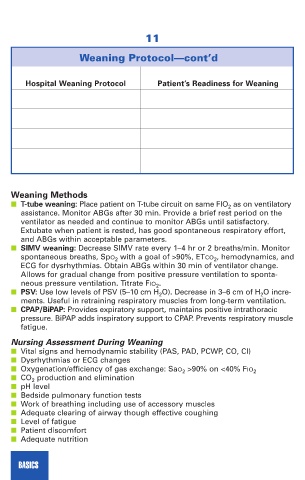
                     Weaning Protocol—cont’d

            Hospital Weaning Protocol  Patient’s Readiness for Weaning


          Weaning Methods
          ■ T-tube weaning: Place patient on T-tube circuit on same FIO 2 as on ventilatory
            assistance. Monitor ABGs after 30 min. Provide a brief rest period on the
            ventilator as needed and continue to monitor ABGs until satisfactory.
            Extubate when patient is rested, has good spontaneous respiratory effort,
            and ABGs within acceptable parameters.
          ■ SIMV weaning: Decrease SIMV rate every 1–4 hr or 2 breaths/min. Monitor
            spontaneous breaths, SpO 2 with a goal of >90%, ETCO 2 , hemodynamics, and
            ECG for dysrhythmias. Obtain ABGs within 30 min of ventilator change.
            Allows for gradual change from positive pressure ventilation to sponta-
            neous pressure ventilation. Titrate FIO 2 .
          ■ PSV: Use low levels of PSV (5–10 cm H 2 O). Decrease in 3–6 cm of H 2 O incre-
            ments. Useful in retraining respiratory muscles from long-term ventilation.
          ■ CPAP/BiPAP: Provides expiratory support, maintains positive intrathoracic
            pressure. BiPAP adds inspiratory support to CPAP. Prevents respiratory muscle
            fatigue.
          Nursing Assessment During Weaning
          ■ Vital signs and hemodynamic stability (PAS, PAD, PCWP, CO, CI)
          ■ Dysrhythmias or ECG changes
          ■ Oxygenation/efficiency of gas exchange: SaO 2 >90% on <40% FIO 2
          ■ CO 2 production and elimination
          ■ pH level
          ■ Bedside pulmonary function tests
          ■ Work of breathing including use of accessory muscles
          ■ Adequate clearing of airway though effective coughing
          ■ Level of fatigue
          ■ Patient discomfort
          ■ Adequate nutrition
           BASICS

