


Page 48 - Critical Care Notes
P. 48
4223_Tab01_001-044  29/08/14  10:46 AM  Page 42


           BASICS

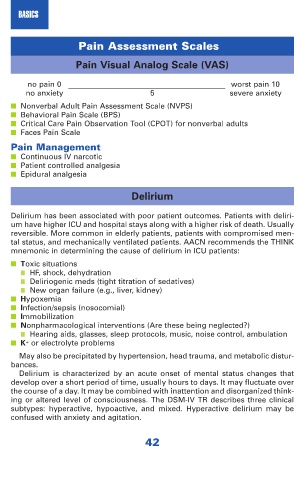
                     Pain Assessment Scales
                     Pain Visual Analog Scale (VAS)
             no pain 0                        worst pain 10
            no anxiety           5            severe anxiety
          ■ Nonverbal Adult Pain Assessment Scale (NVPS)
          ■ Behavioral Pain Scale (BPS)
          ■ Critical Care Pain Observation Tool (CPOT) for nonverbal adults
          ■ Faces Pain Scale
          Pain Management
          ■ Continuous IV narcotic
          ■ Patient controlled analgesia
          ■ Epidural analgesia
                              Delirium
          Delirium has been associated with poor patient outcomes. Patients with deliri-
          um have higher ICU and hospital stays along with a higher risk of death. Usually
          reversible. More common in elderly patients, patients with compromised men-
          tal status, and mechanically ventilated patients. AACN recommends the THINK
          mnemonic in determining the cause of delirium in ICU patients:
          ■ Toxic situations
            ■ HF, shock, dehydration
            ■ Deliriogenic meds (tight titration of sedatives)
            ■ New organ failure (e.g., liver, kidney)
          ■ Hypoxemia
          ■ Infection/sepsis (nosocomial)
          ■ Immobilization
          ■ Nonpharmacological interventions (Are these being neglected?)
            ■ Hearing aids, glasses, sleep protocols, music, noise control, ambulation
          ■ K + or electrolyte problems
           May also be precipitated by hypertension, head trauma, and metabolic distur-
          bances.
           Delirium is characterized by an acute onset of mental status changes that
          develop over a short period of time, usually hours to days. It may fluctuate over
          the course of a day. It may be combined with inattention and disorganized think-
          ing or altered level of consciousness. The DSM-IV TR describes three clinical
          subtypes: hyperactive, hypoactive, and mixed. Hyperactive delirium may be
          confused with anxiety and agitation.
                                42

