


Page 10 - The Netter Collection of Medical Illustrations - Integumentary System_ Volume 4 ( PDFDrive )
P. 10
ABOUT THE ARTIST


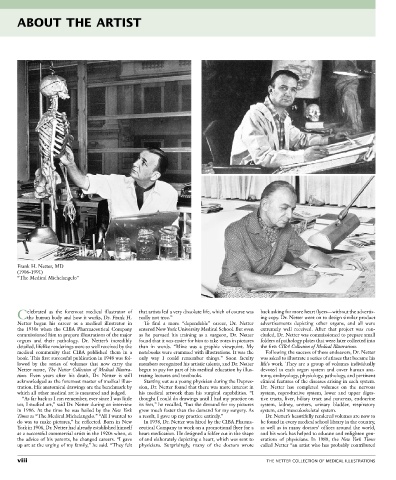
       Frank H. Netter, MD
       (1906-1991)
       “The Medical Michelangelo”


          elebrated  as  the  foremost  medical  illustrator  of   that artists led a very dissolute life, which of course was   back asking for more heart flyers—without the advertis-
       Cthe human body and how it works, Dr. Frank H.   really not true.”                  ing copy. Dr. Netter went on to design similar product
       Netter  began  his  career  as  a  medical  illustrator  in     To  find  a  more  “dependable”  career,  Dr.  Netter   advertisements  depicting  other  organs,  and  all  were
       the  1930s  when  the  CIBA  Pharmaceutical  Company   entered New York University Medical School. But even   extremely  well  received.  After  that  project  was  con-
       commissioned him to prepare illustrations of the major   as  he  pursued  his  training  as  a  surgeon,  Dr.  Netter   cluded, Dr. Netter was commissioned to prepare small
       organs  and  their  pathology.  Dr.  Netter’s  incredibly   found that it was easier for him to take notes in pictures   folders of pathology plates that were later collected into
       detailed, lifelike renderings were so well received by the   than  in  words.  “Mine  was  a  graphic  viewpoint.  My   the first CIBA Collection of Medical Illustrations.
       medical  community  that  CIBA  published  them  in  a   notebooks were crammed with illustrations. It was the   Following the success of these endeavors, Dr. Netter
       book. This first successful publication in 1948 was fol-  only  way  I  could  remember  things.”  Soon  faculty   was asked to illustrate a series of atlases that became his
       lowed  by  the  series  of  volumes  that  now  carry  the   members recognized his artistic talents, and Dr. Netter   life’s work. They are a group of volumes individually
       Netter  name,  The  Netter  Collection  of  Medical  Illustra-  began to pay for part of his medical education by illus-  devoted  to  each  organ  system  and  cover  human  ana-
       tions.  Even  years  after  his  death,  Dr.  Netter  is  still   trating lectures and textbooks.  tomy, embryology, physiology, pathology, and pertinent
       acknowledged as the foremost master of medical illus-  Starting out as a young physician during the Depres-  clinical features of the diseases arising in each system.
       tration. His anatomical drawings are the benchmark by   sion, Dr. Netter found that there was more interest in   Dr.  Netter  has  completed  volumes  on  the  nervous
       which all other medical art is measured and judged.  his  medical  artwork  than  his  surgical  capabilities.  “I   system,  reproductive  system,  lower  and  upper  diges-
         “As far back as I can remember, ever since I was little   thought I could do drawings until I had my practice on   tive tracts, liver, biliary tract and pancreas, endocrine
       tot, I studied art,” said Dr. Netter during an interview   its feet,” he recalled, “but the demand for my pictures   system,  kidney,  ureters,  urinary  bladder,  respiratory
       in  1986.  At  the  time  he  was  hailed  by  the  New  York   grew much faster than the demand for my surgery. As   system, and musculoskeletal system.
       Times as “The Medical Michelangelo.” “All I wanted to   a result, I gave up my practice entirely.”  Dr. Netter’s beautifully rendered volumes are now to
       do was to make pictures,” he reflected. Born in New   In 1938, Dr. Netter was hired by the CIBA Pharma-  be found in every medical school library in the country,
       York in 1906, Dr. Netter had already established himself   ceutical Company to work on a promotional flyer for a   as well as in many doctors’ offices around the world,
       as a successful commercial artist in the 1920s when, at   heart medication. He designed a folder cut in the shape   and his work has helped to educate and enlighten gen-
       the advice of his parents, he changed careers. “I gave   of and elaborately depicting a heart, which was sent to   erations  of  physicians.  In  1988,  the  New  York  Times
       up art at the urging of my family,” he said. “They felt   physicians.  Surprisingly,  many  of  the  doctors  wrote   called Netter “an artist who has probably contributed

       viii                                                                                  THE NETTER COLLECTION OF MEDICAL ILLUSTRATIONS

