


Page 490 - Clinical Application of Mechanical Ventilation
P. 490
456    Chapter 13


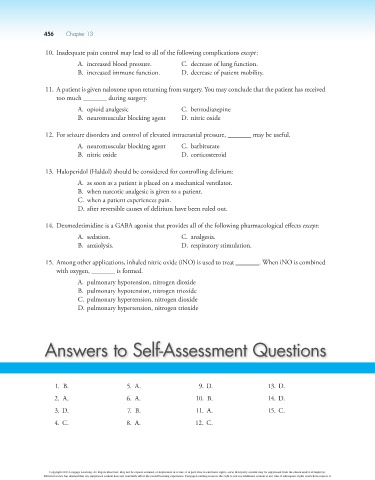
                       10. Inadequate pain control may lead to all of the following complications except :
                                 A.  increased blood pressure.     C.  decrease of lung function.
                                 B.  increased immune function.    D. decrease of patient mobility.


                       11. A patient is given naloxone upon returning from surgery. You may conclude that the patient has received
                          too much _______ during surgery.

                                 A.  opioid analgesic              C.  benzodiazepine
                                 B.  neuromuscular blocking agent   D. nitric oxide


                       12. For seizure disorders and control of elevated intracranial pressure, _______ may be useful.
                                 A.  neuromuscular blocking agent   C.  barbiturate
                                 B.  nitric oxide                  D. corticosteroid

                       13. Haloperidol (Haldol) should be considered for controlling delirium:
                                 A.  as soon as a patient is placed on a mechanical ventilator.
                                 B.  when narcotic analgesic is given to a patient.
                                 C.  when a patient experiences pain.
                                 D. after reversible causes of delirium have been ruled out.

                       14. Dexmedetimidine is a GABA agonist that provides all of the following pharmacological effects except:

                                 A.  sedation.                     C.  analgesia.
                                 B.  anxiolysis.                   D. respiratory stimulation.


                       15. Among other applications, inhaled nitric oxide (iNO) is used to treat _______. When iNO is combined
                          with oxygen, _______ is formed.

                                 A.  pulmonary hypotension, nitrogen dioxide
                                 B.  pulmonary hypotension, nitrogen trioxide
                                 C.  pulmonary hypertension, nitrogen dioxide
                                 D. pulmonary hypertension, nitrogen trioxide


                      Answers to Self-Assessment Questions


                         1.  B.                  5.  A.                  9. D.                 13. D.
                         2.  A.                  6.  A.                10.  B.                 14. D.

                         3. D.                   7.  B.                11.  A.                 15. C.

                         4. C.                   8.  A.                12. C.


                        Copyright 2013 Cengage Learning. All Rights Reserved. May not be copied, scanned, or duplicated, in whole or in part. Due to electronic rights, some third party content may be suppressed from the eBook and/or eChapter(s).
                      Editorial review has deemed that any suppressed content does not materially affect the overall learning experience. Cengage Learning reserves the right to remove additional content at any time if subsequent rights restrictions require it.

