


Page 487 - Clinical Application of Mechanical Ventilation
P. 487
Pharmacotherapy for Mechanical Ventilation  453


                                                                                           Inhalation of
                                                  A                              B
                                                         Obstructed                        Nitric Oxide
                                                         Airway
                                                                   Normal
                                                                   Airway
                                                                                              NO
                                                                                                         Alveoli

                                                                                                    NO


                                                                                                          NO
                                                                                                                © Cengage Learning 2014


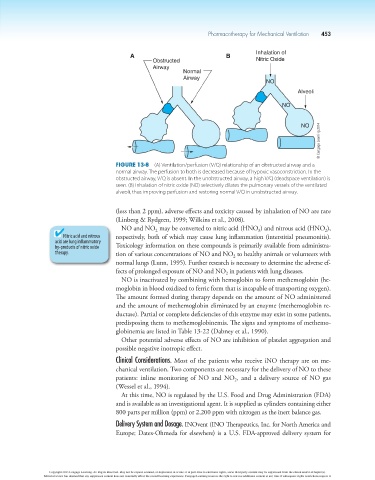
                                             Figure 13-8  (A) Ventilation/perfusion (V/Q) relationship of an obstructed airway and a
                                             normal airway. The perfusion to both is decreased because of hypoxic vasoconstriction. In the
                                             obstructed airway, V/Q is absent. In the unobstructed airway, a high V/Q (deadspace ventilation) is
                                             seen. (B) Inhalation of nitric oxide (NO) selectively dilates the pulmonary vessels of the ventilated
                                             alveoli, thus improving perfusion and restoring normal V/Q in unobstructed airway.

                                             (less than 2 ppm), adverse effects and toxicity caused by inhalation of NO are rare
                                             (Linberg & Rydgren, 1999; Wilkins et al., 2008).
                                               NO and NO  may be converted to nitric acid (HNO ) and nitrous acid (HNO ),
                                                                                                                  2
                                                                                            3
                                                          2
                            Nitric acid and nitrous   respectively, both of which may cause lung inflammation (interstitial pneumonitis).
                          acid are lung inflammatory
                          by-products of nitric oxide   Toxicology information on these compounds is primarily available from administra-
                          therapy.           tion of various concentrations of NO and NO  to healthy animals or volunteers with
                                                                                    2
                                             normal lungs (Lunn, 1995). Further research is necessary to determine the adverse ef-
                                             fects of prolonged exposure of NO and NO  in patients with lung diseases.
                                                                                 2
                                               NO is inactivated by combining with hemoglobin to form methemoglobin (he-
                                             moglobin in blood oxidized to ferric form that is incapable of transporting oxygen).
                                             The amount formed during therapy depends on the amount of NO administered
                                             and the amount of methemoglobin eliminated by an enzyme (methemoglobin re-
                                             ductase). Partial or complete deficiencies of this enzyme may exist in some patients,
                                             predisposing them to methemoglobinemia. The signs and symptoms of methemo-
                                             globinemia are listed in Table 13-22 (Dabney et al., 1990).
                                               Other potential adverse effects of NO are inhibition of platelet aggregation and
                                             possible negative inotropic effect.

                                             Clinical Considerations. Most of the patients who receive iNO therapy are on me-
                                             chanical ventilation. Two components are necessary for the delivery of NO to these
                                             patients: inline monitoring of NO and  NO , and a delivery  source of NO  gas
                                                                                    2
                                             (Wessel et al., 1994).
                                               At this time, NO is regulated by the U.S. Food and Drug Administration (FDA)
                                             and is available as an investigational agent. It is supplied as cylinders containing either
                                             800 parts per million (ppm) or 2,200 ppm with nitrogen as the inert balance gas.

                                             Delivery System and Dosage. INOvent (INO Therapeutics, Inc. for North America and
                                             Europe; Datex-Ohmeda for elsewhere) is a U.S. FDA-approved delivery system for


                        Copyright 2013 Cengage Learning. All Rights Reserved. May not be copied, scanned, or duplicated, in whole or in part. Due to electronic rights, some third party content may be suppressed from the eBook and/or eChapter(s).
                      Editorial review has deemed that any suppressed content does not materially affect the overall learning experience. Cengage Learning reserves the right to remove additional content at any time if subsequent rights restrictions require it.

