


Page 516 - Clinical Application of Mechanical Ventilation
P. 516
482    Chapter 14


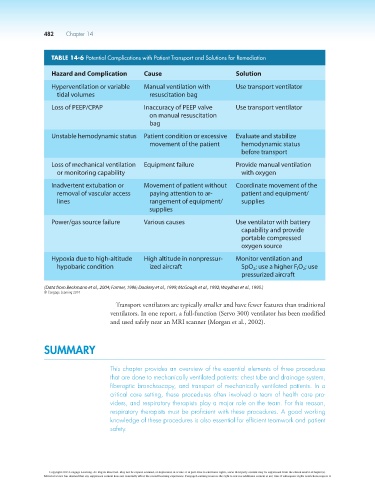
                        TABLE 14-6 Potential Complications with Patient Transport and Solutions for Remediation

                        Hazard and Complication        Cause                         Solution

                        Hyperventilation or variable   Manual ventilation with       Use transport ventilator
                          tidal volumes                 resuscitation bag
                        Loss of PEEP/CPAP              Inaccuracy of PEEP valve      Use transport ventilator
                                                        on manual resuscitation
                                                        bag

                        Unstable hemodynamic status  Patient condition or excessive   Evaluate and stabilize
                                                        movement of the patient       hemodynamic status
                                                                                      before transport

                        Loss of mechanical ventilation  Equipment failure            Provide manual ventilation
                          or monitoring capability                                    with oxygen

                        Inadvertent extubation or      Movement of patient without   Coordinate movement of the
                          removal of vascular access    paying attention to ar-       patient and equipment/
                          lines                         rangement of equipment/       supplies
                                                        supplies

                        Power/gas source failure       Various causes                Use ventilator with battery
                                                                                      capability and provide
                                                                                      portable compressed
                                                                                      oxygen source
                        Hypoxia due to high-altitude   High altitude in nonpressur-  Monitor ventilation and
                          hypobaric condition           ized aircraft                 SpO ; use a higher F O ; use
                                                                                                         I
                                                                                                          2
                                                                                          2
                                                                                      pressurized aircraft
                      (Data from Beckmann et al., 2004; Farmer, 1996; Dockery et al., 1999; McGough et al., 1992; Waydhas et al., 1995.)
                      © Cengage Learning 2014
                                             Transport ventilators are typically smaller and have fewer features than traditional
                                            ventilators. In one report, a full-function (Servo 300) ventilator has been modified
                                            and used safely near an MRI scanner (Morgan et al., 2002).


                      SUmmaRy


                                            This chapter provides an overview of the essential elements of three procedures
                                            that are done to mechanically ventilated patients: chest tube and drainage system,
                                            fiberoptic bronchoscopy, and transport of mechanically ventilated patients. In a
                                            critical care setting, these procedures often involved a team of health care pro-
                                            viders, and respiratory therapists play a major role on the team. For this reason,
                                            respiratory therapists must be proficient with these procedures. A good working
                                            knowledge of these procedures is also essential for efficient teamwork and patient
                                            safety.


                        Copyright 2013 Cengage Learning. All Rights Reserved. May not be copied, scanned, or duplicated, in whole or in part. Due to electronic rights, some third party content may be suppressed from the eBook and/or eChapter(s).
                      Editorial review has deemed that any suppressed content does not materially affect the overall learning experience. Cengage Learning reserves the right to remove additional content at any time if subsequent rights restrictions require it.

