


Page 655 - Clinical Application of Mechanical Ventilation
P. 655
Case	Studies  621


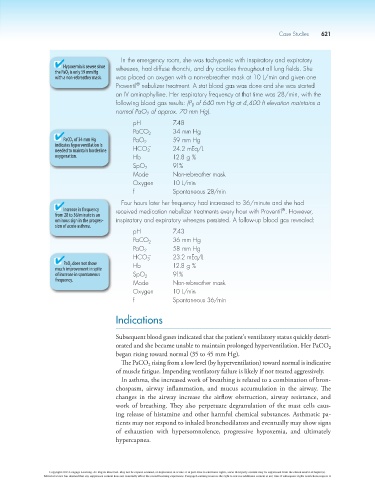
                                               In	the	emergency	room,	she	was	tachypneic	with	inspiratory	and	expiratory
                            Hypoxemia is severe since   wheezes,	had	diffuse	rhonchi,	and	dry	crackles	throughout	all	lung	fields.	She
                          the PaO 2  is only 59 mm Hg
                          with a non-rebreather mask.  was	placed	on	oxygen	with	a	non-rebreather	mask	at	10	L/min	and	given	one
                                                    ®
                                             Proventil 	nebulizer	treatment.	A	stat	blood	gas	was	done	and	she	was	started
                                             on	IV	aminophylline.	Her	respiratory	frequency	at	that	time	was	28/min,	with	the
                                             following	blood	gas	results:	(P  of 640 mm Hg at 4,400 ft elevation maintains a
                                                                      B
                                             normal PaO  of approx. 70 mm Hg).
                                                       2
                                             	     pH	          7.48
                                             	     PaCO 2	      34	mm	Hg
                            PaCO 2  of 34 mm Hg   	  PaO        59	mm	Hg
                          indicates hyperventilation is   2	  -
                          needed to maintain borderline   	  HCO 3 	  24.2	mEq/L
                          oxygenation.       	     Hb	          12.8	g	%
                                             	     SpO 2	       91%
                                             	     Mode	        Non-rebreather	mask
                                             	     Oxygen	      10	L/min
                                             	     f	           Spontaneous	28/min

                                               Four	hours	later	her	frequency	had	increased	to	36/minute	and	she	had
                            Increase in frequency   received	medication	nebulizer	treatments	every	hour	with	Proventil .	However,
                                                                                                    ®
                          from 28 to 36/minute is an
                          ominous sign in the progres-  inspiratory	and	expiratory	wheezes	persisted.	A	follow-up	blood	gas	revealed:
                          sion of acute asthma.
                                             	     pH	          7.43
                                             	     PaCO 2	      36	mm	Hg
                                             	     PaO 2	       58	mm	Hg
                                                        -
                                             	     HCO 	        23.2	mEq/L
                                                        3
                            PaO 2  does not show   	  Hb	       12.8	g	%
                          much improvement in spite
                          of increase in spontaneous   	  SpO 2	  91%
                          frequency.
                                             	     Mode	        Non-rebreather	mask
                                             	     Oxygen	      10	L/min
                                             	     f	           Spontaneous	36/min

                                             Indications


                                             Subsequent blood gases indicated that the patient’s ventilatory status quickly deteri-
                                             orated and she became unable to maintain prolonged hyperventilation. Her PaCO
                                                                                                                   2
                                             began rising toward normal (35 to 45 mm Hg).
                                               The PaCO  rising from a low level (by hyperventilation) toward normal is indicative
                                                        2
                                             of muscle fatigue. Impending ventilatory failure is likely if not treated aggressively.
                                               In asthma, the increased work of breathing is related to a combination of bron-
                                             chospasm,  airway  inflammation,  and  mucus  accumulation  in  the  airway.  The
                                             changes  in  the  airway  increase  the  airflow  obstruction,  airway  resistance,  and
                                             work of breathing. They also perpetuate degranulation of the mast cells caus-
                                             ing release of histamine and other harmful chemical substances. Asthmatic pa-
                                             tients may not respond to inhaled bronchodilators and eventually may show signs
                                             of  exhaustion  with  hypersomnolence,  progressive  hypoxemia,  and  ultimately
                                             hypercapnea.


                        Copyright 2013 Cengage Learning. All Rights Reserved. May not be copied, scanned, or duplicated, in whole or in part. Due to electronic rights, some third party content may be suppressed from the eBook and/or eChapter(s).
                      Editorial review has deemed that any suppressed content does not materially affect the overall learning experience. Cengage Learning reserves the right to remove additional content at any time if subsequent rights restrictions require it.

