


Page 661 - Clinical Application of Mechanical Ventilation
P. 661
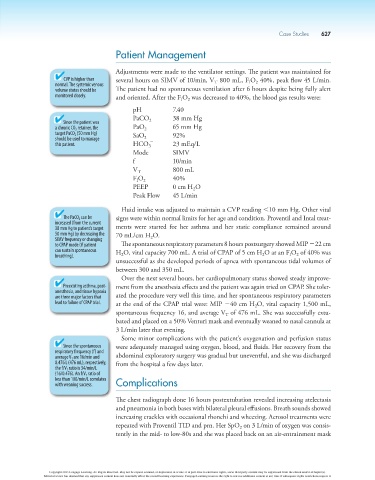
Case	Studies  627


                                             Patient Management


                                             Adjustments were made to the ventilator settings. The patient was maintained for
                            CVP is higher than   several hours on SIMV of 10/min, V  800 mL, F O  40%, peak flow 45 L/min.
                          normal. The systemic venous                         T          I  2
                          volume status should be   The patient had no spontaneous ventilation after 6 hours despite being fully alert
                          monitored closely.  and oriented. After the F O  was decreased to 40%, the blood gas results were:
                                                                     2
                                                                   I
                                                   pH           7.40
                                                   PaCO         38 mm Hg
                            Since the patient was       2
                          a chronic CO 2  retainer, the      PaO 2   65 mm Hg
                          target PaCO 2  (50 mm Hg)      SaO    92%
                          should be used to manage     2
                                                         -
                          this patient.            HCO          23 mEq/L
                                                        3
                                                   Mode         SIMV
                                                   f            10/min
                                                   V T          800 mL
                                                   F O 2        40%
                                                    I
                                                   PEEP         0 cm H O
                                                                       2
                                                   Peak Flow    45 L/min
                                               Fluid intake was adjusted to maintain a CVP reading ,10 mm Hg. Other vital
                            The PaCO 2  can be   signs were within normal limits for her age and condition. Proventil and Intal treat-
                          increased (from the current
                          38 mm Hg to patient’s target   ments  were  started  for  her  asthma  and  her  static  compliance  remained  around
                          50 mm Hg) by decreasing the   70 mL/cm H O.
                          SIMV frequency or changing     2
                          to CPAP mode (if patient   The spontaneous respiratory parameters 8 hours postsurgery showed MIP 222 cm
                          can sustain spontaneous   H O, vital capacity 700 mL. A trial of CPAP of 5 cm H O at an F O  of 40% was
                          breathing).          2                                             2        I  2
                                             unsuccessful as she developed periods of apnea with spontaneous tidal volumes of
                                             between 300 and 350 mL.
                                               Over the next several hours, her cardiopulmonary status showed steady improve-
                            Preexisting asthma, post-  ment from the anesthesia effects and the patient was again tried on CPAP. She toler-
                          anesthesia, and tissue hypoxia
                          are three major factors that   ated the procedure very well this time, and her spontaneous respiratory parameters
                          lead to failure of CPAP trial.  at the end of the CPAP trial were: MIP 240 cm H O, vital capacity 1,500 mL,
                                                                                           2
                                             spontaneous frequency 16, and average V  of 476 mL. She was successfully extu-
                                                                                 T
                                             bated and placed on a 50% Venturi mask and eventually weaned to nasal cannula at
                                             3 L/min later that evening.
                                               Some minor complications with the patient’s oxygenation and perfusion status
                            Since the spontaneous   were adequately managed using oxygen, blood, and fluids. Her recovery from the
                          respiratory frequency (f) and
                          average V T  are 16/min and   abdominal exploratory surgery was gradual but uneventful, and she was discharged
                          0.476 L (476 mL), respectively,   from the hospital a few days later.
                          the f/V T  ratio is 34/min/L
                          (16/0.476). An f/V T  ratio of
                          less than 100/min/L correlates   Complications
                          with weaning success.

                                             The chest radiograph done 16 hours postextubation revealed increasing atelectasis
                                             and pneumonia in both bases with bilateral pleural effusions. Breath sounds showed
                                             increasing crackles with occasional rhonchi and wheezing. Aerosol treatments were
                                             repeated with Proventil TID and prn. Her SpO  on 3 L/min of oxygen was consis-
                                                                                      2
                                             tently in the mid- to low-80s and she was placed back on an air-entrainment mask


                        Copyright 2013 Cengage Learning. All Rights Reserved. May not be copied, scanned, or duplicated, in whole or in part. Due to electronic rights, some third party content may be suppressed from the eBook and/or eChapter(s).
                      Editorial review has deemed that any suppressed content does not materially affect the overall learning experience. Cengage Learning reserves the right to remove additional content at any time if subsequent rights restrictions require it.

