


Page 666 - Clinical Application of Mechanical Ventilation
P. 666
632    Chapter	19


                                            The	initial	blood	pressure	was	139/100	mm	Hg,	temperature	was	35.8°C	with	a
                          Cyanide is one of the by-  pulse	of	102/min,	and	respiratory	frequency	of	24/min	while	breathing	on	a	non-
                        products of combustion.
                                            rebreather	mask	at	15	L/min.	He	was	immediately	fluid-resuscitated	with	1,000	mL
                                            of	D W,	and	treated	empirically	for	cyanide	toxicity,	which	interferes	with	oxidative
                                               5
                                            metabolism	at	the	cellular	level	by	impairing	the	utilization	of	oxygen	in	the	tissues.
                          With adequate spontane-  The	clinical	signs	of	cyanide	poisoning	at	different	toxic	levels	may	include	the
                        ous ventilation, the initial   following:
                        supportive measure for smoke
                        inhalation is 100% O 2 .
                                            	    Blood	cyanide	concentration	0.2	to	0.3	mg/L	 c	HR,	c	RR,	dizziness
                                            	    Blood	cyanide	concentration	0.3	to	1	mg/L	  c	Lethargy,	arrhythmias,	apnea
                                            	    Blood	cyanide	concentration	.1	mg/L		   Death
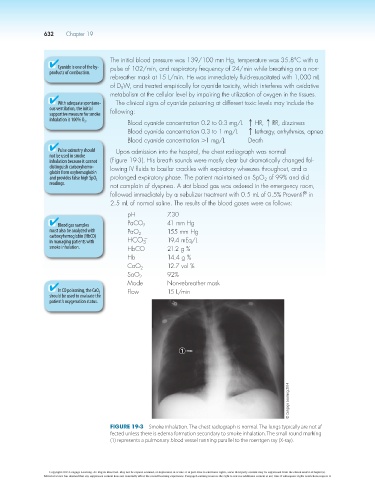
                          Pulse oximetry should   Upon	admission	into	the	hospital,	the	chest	radiograph	was	normal
                        not be used in smoke
                        inhalation because it cannot   (Figure	19-3).	His	breath	sounds	were	mostly	clear	but	dramatically	changed	fol-
                        distinguish carboxyhemo-  lowing	IV	fluids	to	basilar	crackles	with	expiratory	wheezes	throughout,	and	a
                        globin from oxyhemoglobin
                        and provides false high SpO 2    prolonged	expiratory	phase.	The	patient	maintained	an	SpO 	of	99%	and	did
                                                                                              2
                        readings.           not	complain	of	dyspnea.	A	stat	blood	gas	was	ordered	in	the	emergency	room,
                                                                                                           ®
                                            followed	immediately	by	a	nebulizer	treatment	with	0.5	mL	of	0.5%	Proventil 	in
                                            2.5 mL	of	normal	saline.	The	results	of	the	blood	gases	were	as	follows:
                                            	    pH	          7.30
                          Blood gas samples   	  PaCO 2	      41	mm	Hg
                        must also be analyzed with   	  PaO   155	mm	Hg
                        carboxyhemoglobin (HbCO)     2	  -
                        in managing patients with   	  HCO 	  19.4	mEq/L
                                                      3
                        smoke inhalation.   	    HbCO	        21.2	g	%
                                            	    Hb	          14.4	g	%
                                            	    CaO 2	       12.7	vol	%
                                            	    SaO 2	       92%
                                            	    Mode	        Non-rebreather	mask
                          In CO poisoning, the CaO 2    	  Flow	  15	L/min
                        should be used to evaluate the
                        patient’s oxygenation status.


                                                                   1


                                                                                                      © Cengage Learning 2014


                                            Figure 19-3  Smoke inhalation. The chest radiograph is normal. The lungs typically are not af-
                                            fected unless there is edema formation secondary to smoke inhalation. The small round marking
                                            (1) represents a pulmonary blood vessel running parallel to the roentgen ray (X-ray).


                        Copyright 2013 Cengage Learning. All Rights Reserved. May not be copied, scanned, or duplicated, in whole or in part. Due to electronic rights, some third party content may be suppressed from the eBook and/or eChapter(s).
                      Editorial review has deemed that any suppressed content does not materially affect the overall learning experience. Cengage Learning reserves the right to remove additional content at any time if subsequent rights restrictions require it.

