


Page 104 - AACN Essentials of Critical-Care Nursing Pocket Handbook, Second Edition
P. 104
91


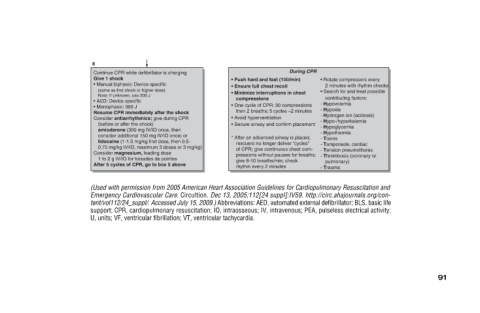
                  • Rotate compressors every 2 minutes with rhythm checks • Search for and treat possible   contributing factors:  - Hypovolemia  - Hypoxia - Hydrogen ion (acidosis)  - Hypo-/hyperkalemia  - Hypoglycemia  - Hypothermia  - Toxins - Tamponade, cardia


                During CPR
                  • Push hard and fast (100/min) • Ensure full chest recoil • Minimize interruptions in chest   compressions • One cycle of CPR: 30 compressions then 2 breaths; 5 cycles ≈2 minutes    • Avoid hyperventilation • Secure airway and confirm placement


                 Continue CPR while defibrillator is charging  • Manual biphasic: Device specific (same as first shock or higher dose) Note: If unknown, use 200 J • AED: Device specific Resume CPR immediately after the shock Consider antiarrhythmics; give during C
              Shockable         0.75 mg/kg IV/IO, maximum 3 doses or 3 mg/kg)  U, units; VF, ventricular fibrillation; VT, ventricular tachycardia.


               8  Give 1 shock     • Monophasic: 360 J

