


Page 14 - Cardiac Nursing
P. 14
/
                                 09
                                /
                              30
                              30
                                    1:
                                     13
                                    1:
                                 09
                                    1:
                             /
                         x
                          d
                         x
                        q
                         x
                            6
                             /
                            6
                          d
                            6
                                     13
                                                  p
                                                  p
                                                i A
                                                i A
                                                i A
                                                     r
                                                     r
                                                   ta
                                                  p
                                                   ta
                                               vii
                                           Pa
                                             g
                                           Pa
                                        PM
                                        PM
                                             e
                                               vii
                                             e
                                             g
                                             g
         LWB K34 0-F M_ ppi-xviii.qxd  6/30/09  1:13 PM  Page viii Aptara a a
         L L LWB
                   p
                   p
               0-F
                 M_
         LWBK340-F0-FM_
            K34
                    i-x
                       i.
                       i.
                        q
                        q
                      vii
                    i-x
                       i.
                      vii
                  viii  About the Editors
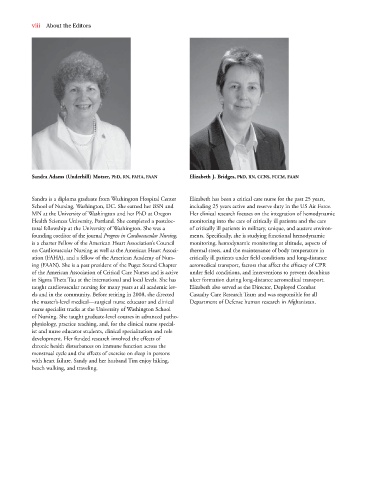
                  Sandra Adams (Underhill) Motzer, PhD, RN, FAHA, FAAN  Elizabeth J. Bridges, PhD, RN, CCNS, FCCM, FAAN
                  Sandra is a diploma graduate from Washington Hospital Center  Elizabeth has been a critical care nurse for the past 25 years,
                  School of Nursing, Washington, DC. She earned her BSN and  including 25 years active and reserve duty in the US Air Force.
                  MN at the University of Washington and her PhD at Oregon  Her clinical research focuses on the integration of hemodynamic
                  Health Sciences University, Portland. She completed a postdoc-  monitoring into the care of critically ill patients and the care
                  toral fellowship at the University of Washington. She was a  of critically ill patients in military, unique, and austere environ-
                  founding coeditor of the journal Progress in Cardiovascular Nursing,  ments. Specifically, she is studying functional hemodynamic
                  is a charter Fellow of the American Heart Association’s Council  monitoring, hemodynamic monitoring at altitude, aspects of
                  on Cardiovascular Nursing as well as the American Heart Associ-  thermal stress, and the maintenance of body temperature in
                  ation (FAHA), and a fellow of the American Academy of Nurs-  critically ill patients under field conditions and long-distance
                  ing (FAAN). She is a past president of the Puget Sound Chapter  aeromedical transport, factors that affect the efficacy of CPR
                  of the American Association of Critical Care Nurses and is active  under field conditions, and interventions to prevent decubitus
                  in Sigma Theta Tau at the international and local levels. She has  ulcer formation during long-distance aeromedical transport.
                  taught cardiovascular nursing for many years at all academic lev-  Elizabeth also served as the Director, Deployed Combat
                  els and in the community. Before retiring in 2008, she directed  Casualty Care Research Team and was responsible for all
                  the master’s-level medical—surgical nurse educator and clinical  Department of Defense human research in Afghanistan.
                  nurse specialist tracks at the University of Washington School
                  of Nursing. She taught graduate-level courses in advanced patho-
                  physiology, practice teaching, and, for the clinical nurse special-
                  ist and nurse educator students, clinical specialization and role
                  development. Her funded research involved the effects of
                  chronic health disturbances on immune function across the
                  menstrual cycle and the effects of exercise on sleep in persons
                  with heart failure. Sandy and her husband Tim enjoy hiking,
                  beach walking, and traveling.

